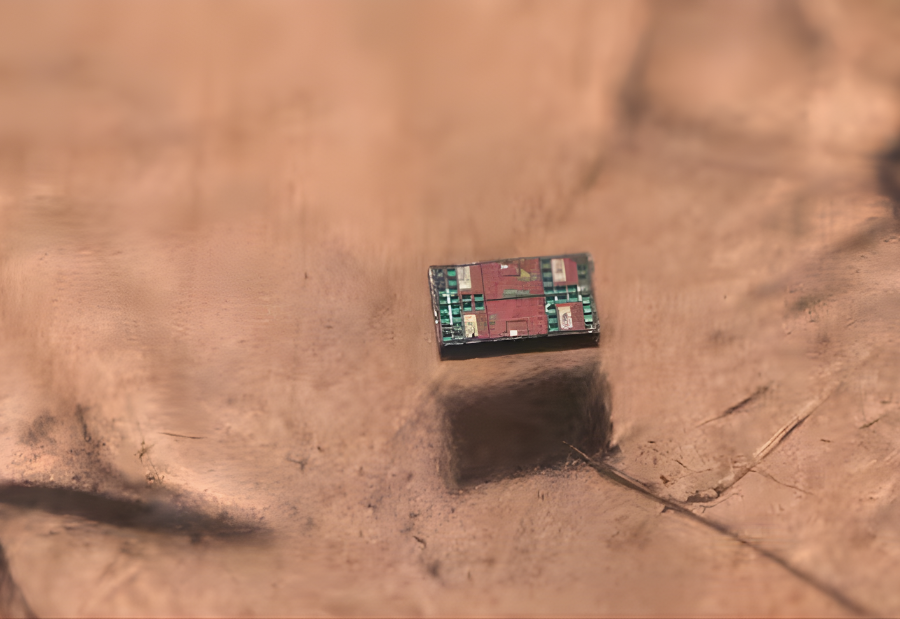
A major step forward in robotics research is opening new possibilities for future medical treatment at a microscopic scale. Researchers from the University of Pennsylvania and the University of Michigan have created an ultra tiny robot that is smaller than a grain of salt.
The sub millimeter sized microrobot contains a computer, motor, and sensors packed into a compact structure. The research, published in the journal Science Robotics, points to a future where microscopic robots could perform complex tasks inside the human body.
The microrobot could one day help repair damaged tissues or deliver treatment to areas that are difficult to reach using current medical tools. “It’s the first tiny robot to be able to sense, think and act,” said co author Marc Miskin, assistant professor of electrical and systems engineering at the University of Pennsylvania, in an interview with a newspaper. Researchers stressed that the technology is still experimental and not ready for use inside the human body.
Building microrobots that can move, sense their surroundings, and process information on their own has challenged scientists for decades. The research team explained that earlier approaches relied on external control, which limited the robots’ ability to process information independently. This reduced their interaction with the environment and restricted real world use.
Miskin said robots at the micron scale, equal to 1 millionth of a meter, could provide access to the smallest building blocks of biology. He noted that “every living thing is basically a giant composite of 100 micron robots,” highlighting how nature relies on this scale to organise life.
The robot resembles a tiny microchip and is built using silicon, platinum, and titanium. It is coated with a glass like layer to protect it from fluids. Solar cells convert energy to power the onboard computer and movement system. The robot swims by using 2 electrodes that create motion in surrounding water particles.
The microrobot can send and receive messages with human operators, sharing details about its actions and observations. Researchers now aim to enable communication between multiple microrobots. “So the next holy grail really is for them to communicate with each other,” said co author David Blaauw from the University of Michigan in an interview with a newspaper. This advance could greatly improve the use of microrobots in future medical applications.
Also read: Viksit Workforce for a Viksit Bharat
Do Follow: The Mainstream formerly known as CIO News LinkedIn Account | The Mainstream formerly known as CIO News Facebook | The Mainstream formerly known as CIO News Youtube | The Mainstream formerly known as CIO News Twitter
About us:
The Mainstream is a premier platform delivering the latest updates and informed perspectives across the technology business and cyber landscape. Built on research-driven, thought leadership and original intellectual property, The Mainstream also curates summits & conferences that convene decision makers to explore how technology reshapes industries and leadership. With a growing presence in India and globally across the Middle East, Africa, ASEAN, the USA, the UK and Australia, The Mainstream carries a vision to bring the latest happenings and insights to 8.2 billion people and to place technology at the centre of conversation for leaders navigating the future.