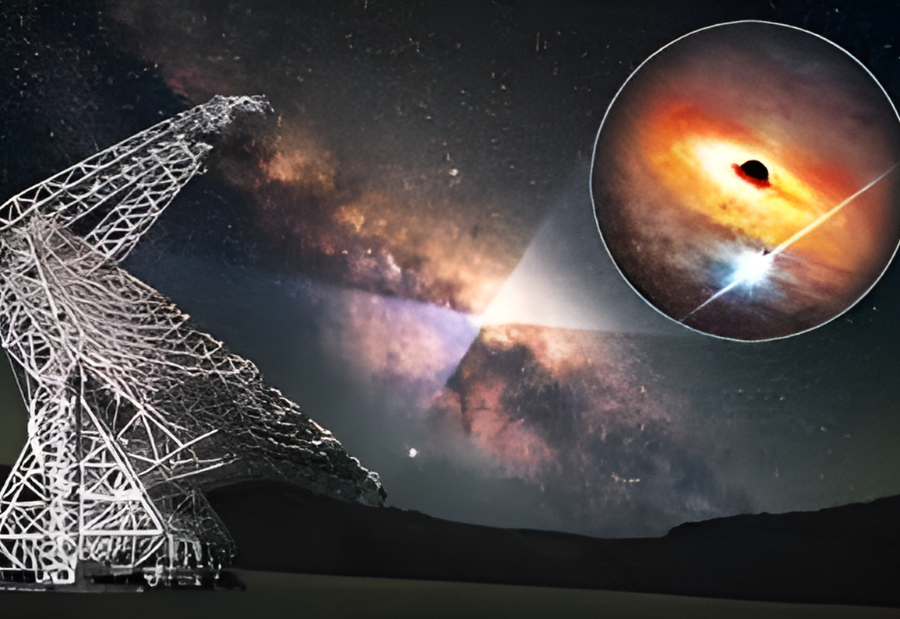
A newly detected radio signal from the heart of the Milky Way could open a rare opportunity to study gravity under extreme conditions. Scientists believe the signal may come from a pulsar located close to the galaxy’s supermassive black hole, Sagittarius A*, which holds the mass of 4 million suns.
Pulsars are ultradense remnants of massive stars, known as neutron stars. Often described as “cosmic lighthouses,” they emit beams of radio waves with each rapid spin. These beams sometimes sweep past Earth, appearing as repeating pulses. The suspected pulsar rotates every 8.19 milliseconds and sits near Sagittarius A* at the center of the Milky Way.
The findings were published on Monday (Feb. 9) in The Astrophysical Journal. The research was led by Karen Perez, a postdoctoral researcher at the SETI Institute, who conducted the study as a doctoral student at Columbia University.
“We’re looking forward to what follow-up observations might reveal about this pulsar candidate,” Perez said in a statement. She added that the team hopes to use the object to test aspects of general relativity.
Albert Einstein’s theory of general relativity explains gravity not as a force, but as the curvature of space-time caused by mass. A pulsar located near a supermassive black hole provides an ideal laboratory for testing this idea.
According to researchers, such a pulsar could allow for “precision measurements of the space-time around a supermassive black hole.” Because pulsars spin extremely fast, they are sensitive to even subtle gravitational effects from nearby massive objects.
The pulsar’s rapid rotation could, in theory, create “anomalies” in the pulses of light detected on Earth, said study co-author Slavko Bogdanov of the Columbia Astrophysics Laboratory.
“In addition, when the pulses travel near a very massive object, they may be deflected and experience time delays due to the warping of space-time, as predicted by Einstein’s general theory of relativity,” Bogdanov added.
The signal was detected through Breakthrough Listen, a research program searching for signs of civilizations beyond Earth. The discovery emerged from the Breakthrough Listen Galactic Center Survey, focused on signals from the Milky Way’s core. All data has been released publicly, “allowing researchers worldwide to pursue independent analyses and complementary science cases.”
Further studies are required to confirm whether the signal is truly from a pulsar or another unusual radio source.
Also read: Viksit Workforce for a Viksit Bharat
Do Follow: The Mainstream formerly known as CIO News LinkedIn Account | The Mainstream formerly known as CIO News Facebook | The Mainstream formerly known as CIO News Youtube | The Mainstream formerly known as CIO News Twitter
About us:
The Mainstream is a premier platform delivering the latest updates and informed perspectives across the technology business and cyber landscape. Built on research-driven, thought leadership and original intellectual property, The Mainstream also curates summits & conferences that convene decision makers to explore how technology reshapes industries and leadership. With a growing presence in India and globally across the Middle East, Africa, ASEAN, the USA, the UK and Australia, The Mainstream carries a vision to bring the latest happenings and insights to 8.2 billion people and to place technology at the centre of conversation for leaders navigating the future.