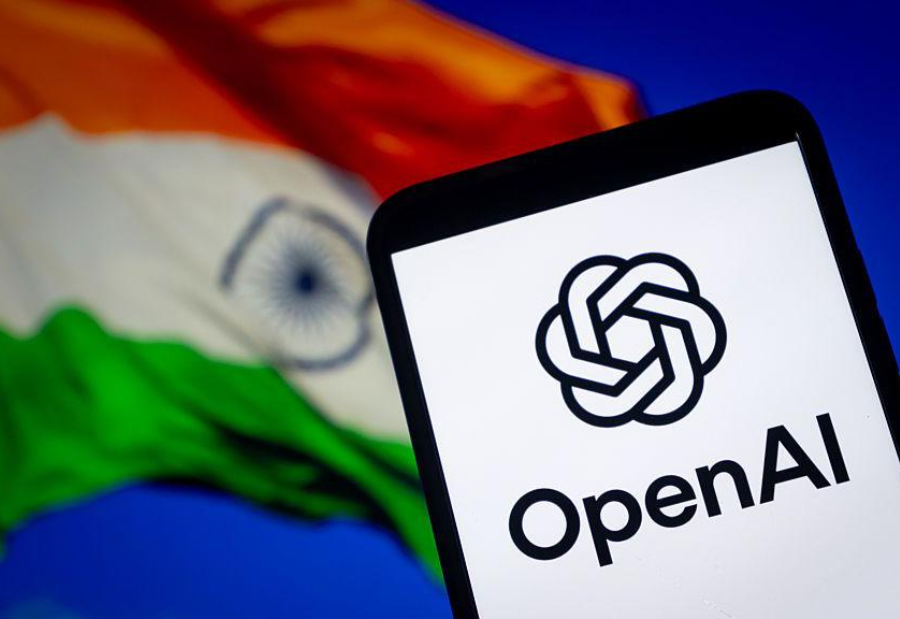
At a time when artificial intelligence adoption is accelerating worldwide, OpenAI has placed India at the core of its long-term global growth strategy, highlighting the country’s scale, speed of adoption, and developer strength.
Speaking on the sidelines of the World Economic Forum in Davos, Christopher Lehane, Chief Global Affairs Officer at OpenAI, said India has emerged as the company’s second-largest consumer market globally, after the United States, and is also among its fastest-growing regions.
“In the last 12 months alone, we’ve seen 2.5x growth in India. Today, India is our second-largest consumer market in the world and a top-five country for developers,” Lehane said. “India is not a testing ground. It is one of our most important markets.”
OpenAI made ChatGPT free for users in India in November 2025, a move that quickly positioned the country among the largest markets with unrestricted access to advanced AI tools. According to Lehane, this step reflects the company’s belief that India will be one of the biggest beneficiaries of the AI revolution.
“We will always have a free baseline model. We’ve even offered more powerful models free in India as a signal of our long-term commitment,” he said. “India sits right at the top of our priority list.”
To support free access, OpenAI has also begun testing advertising globally. Lehane said this approach is aimed at keeping AI widely available while continuing to invest in research, safety, and infrastructure.
“We’re testing ads so more people can benefit from AI without having to pay. But free access will always remain central to our strategy,” he added.
Lehane pointed to India’s vast scale, strong developer ecosystem, and rapid adoption as key factors shaping the next phase of AI-led growth.
“India is not just producing great engineers. It’s producing world-class AI researchers,” he said. “This is not social media. AI is a productivity technology. Think of it like electricity, we provide the power, and people build entire industries on top of it.”
OpenAI said more than 850 million people worldwide now use AI tools regularly, with over 4 million developers and 1 million companies building on its technology. India ranks among the company’s top markets across both consumer and developer metrics.
Dismissing concerns that AI is a bubble, Lehane said OpenAI data shows individuals and companies using AI effectively are seeing a 7x increase in economic productivity.
“AI is a general-purpose technology like the wheel, the combustion engine or the semiconductor,” he said. “Countries that integrate AI will see rapid economic gains. Those that don’t risk being left behind.”
With India set to host a major global AI summit later this year, Lehane said the country will play a defining role in shaping the next phase of the Intelligence Age.
“India is one of the most important countries for OpenAI,” he said. “Its population, growth trajectory and global role put it right at the centre of the AI revolution.”
Also read: Viksit Workforce for a Viksit Bharat
Do Follow: The Mainstream formerly known as CIO News LinkedIn Account | The Mainstream formerly known as CIO News Facebook | The Mainstream formerly known as CIO News Youtube | The Mainstream formerly known as CIO News Twitter
About us:
The Mainstream is a premier platform delivering the latest updates and informed perspectives across the technology business and cyber landscape. Built on research-driven, thought leadership and original intellectual property, The Mainstream also curates summits & conferences that convene decision makers to explore how technology reshapes industries and leadership. With a growing presence in India and globally across the Middle East, Africa, ASEAN, the USA, the UK and Australia, The Mainstream carries a vision to bring the latest happenings and insights to 8.2 billion people and to place technology at the centre of conversation for leaders navigating the future.