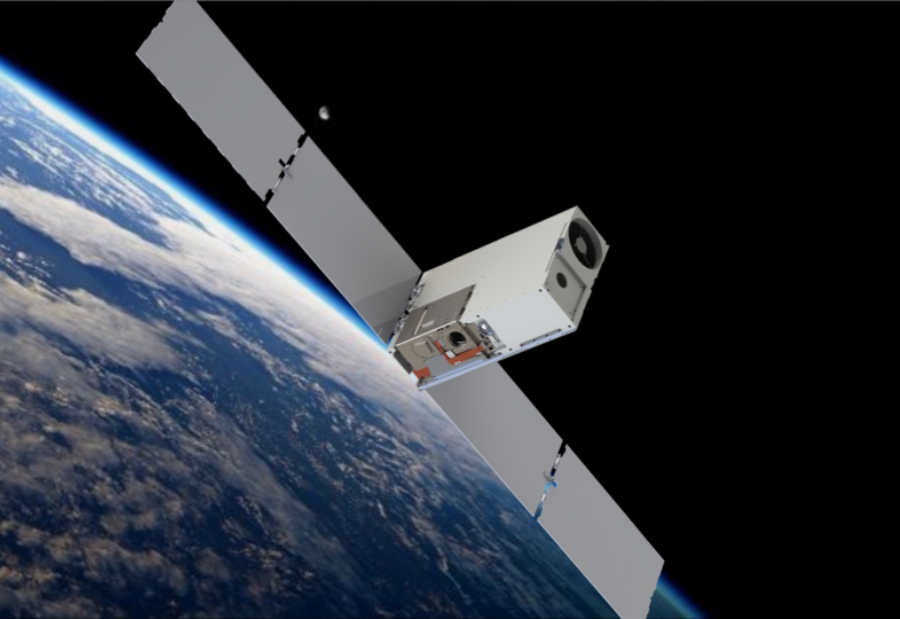
NASA’s Star-Planet Activity Research CubeSat (SPARCS) has successfully delivered its “first light” images, marking a key milestone in its mission to study the habitability of planets beyond our solar system.
Launched on January 11, 2026, the small space telescope was developed by NASA in collaboration with researchers from the School of Earth and Space Exploration at the University of Arizona. The mission focuses on observing flares and sunspot activity in low-mass stars, including M-type red dwarfs and K-type orange dwarfs, using far- and near-ultraviolet instruments.
SPARCS is a 6U CubeSat, built from 6 units measuring 10 cm each, forming a compact spacecraft 2 units wide and 3 units long. On February 6, 2026, it captured its first images of a distant star system, confirming that its instruments are functioning as expected and ready for full science operations.
The telescope’s initial observations targeted HD 71262, a K-type star located about 650 light-years away in the Sculptor constellation. SPARCS recorded the system in both near-ultraviolet and far-ultraviolet wavelengths, offering distinct views of the star and its surrounding background.
The mission aims to better understand stars that dominate the galaxy. M-type red dwarfs make up around 75% of main-sequence stars, while K-type stars account for 11% to 12%. Scientists are particularly interested in whether these stars can support habitable planets, especially given their intense flare activity and ultraviolet radiation, which can significantly impact planetary atmospheres.
“Seeing SPARCS’ first ultraviolet images from orbit is incredibly exciting,” said SPARCS Principal Investigator Evgenya Shkolnik. “They tell us the spacecraft, the telescope, and the detectors are performing as tested on the ground, and we are ready to begin the science we built this mission to do.”
The mission uses advanced detector-integrated filters built on “delta-doped” detectors, eliminating the need for separate filtering components and enhancing sensitivity. It also features an onboard computer with machine learning algorithms that can process data and adjust observations in real time, improving the study of stellar flare activity.
“I am so excited that we are on the brink of learning about exoplanets’ host stars and the effect of their activities on the planets’ potential habitability,” said Shouleh Nikzad of NASA’s Jet Propulsion Laboratory. “That is a huge leap forward to doing big science in small packages.”
The insights from SPARCS are expected to support future missions such as the Habitable Worlds Observatory and the UltraViolet EXplorer, helping scientists better understand stellar environments and the potential for life on distant worlds.
Also read: Viksit Workforce for a Viksit Bharat
Do Follow: The Mainstream LinkedIn | The Mainstream Facebook | The Mainstream Youtube | The Mainstream Twitter
About us:
The Mainstream is a premier platform delivering the latest updates and informed perspectives across the technology business and cyber landscape. Built on research-driven, thought leadership and original intellectual property, The Mainstream also curates summits & conferences that convene decision makers to explore how technology reshapes industries and leadership. With a growing presence in India and globally across the Middle East, Africa, ASEAN, the USA, the UK and Australia, The Mainstream carries a vision to bring the latest happenings and insights to 8.2 billion people and to place technology at the centre of conversation for leaders navigating the future.