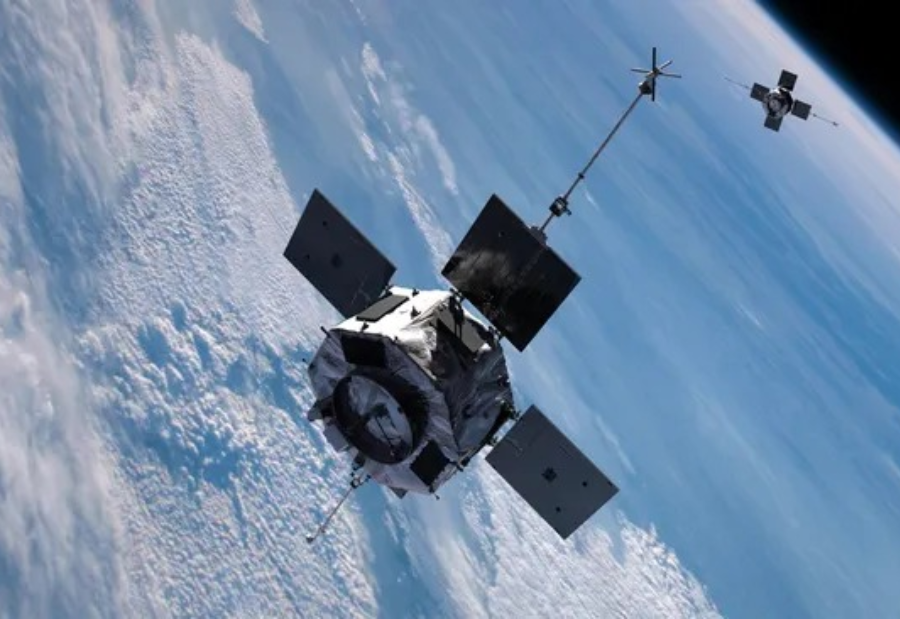
A large satellite built by NASA is expected to fall back to Earth on March 10 after spending nearly 14 years in space. Experts say the spacecraft will burn up in the atmosphere during reentry, with only a small chance that fragments could reach the surface.
The object is Van Allen Probe A, which weighs about 1,323 pounds (600 kilograms). It was launched in August 2012 alongside its twin satellite, Van Allen Probe B, to study the radiation belts surrounding Earth.
Both spacecraft were part of a mission designed to better understand the powerful radiation zones known as the Van Allen radiation belts. These belts can influence satellites, astronauts and communication systems.
According to the United States Space Force, the satellite was predicted to reenter Earth’s atmosphere on Tuesday at around 7:45 p.m. EDT (2345 GMT), with a margin of error of about 24 hours.
“NASA expects most of the spacecraft to burn up as it travels through the atmosphere, but some components are expected to survive reentry,” NASA officials said in a recent update. “The risk of harm coming to anyone on Earth is low — approximately 1 in 4,200.”
The estimated probability of injury is about 0.02%. Since around 70% of Earth’s surface is covered by water, any surviving debris will most likely fall into the ocean rather than populated areas.
The predicted reentry time remains an estimate and may change as scientists gather more data and refine calculations.
The Van Allen Probes were originally known as the Radiation Belt Storm Probes. They operated in a highly elliptical orbit that took them as far as 18,900 miles (30,415 kilometers) from Earth and as close as 384 miles (618 kilometers).
The mission was initially planned to last 2 years. However, the spacecraft continued functioning much longer, operating until July 2019 for Probe B and October 2019 for Probe A. During that time, the satellites collected valuable data that scientists still analyse today.
“By reviewing archived data from the mission, scientists study the radiation belts surrounding Earth, which are key to predicting how solar activity impacts satellites, astronauts, and even systems on Earth such as communications, navigation and power grids,” NASA officials said. “By observing these dynamic regions, the Van Allen Probes contributed to improving forecasts of space weather events and their potential consequences.”
Originally, both satellites were expected to remain in orbit until 2034. However, increased solar activity in recent years has expanded Earth’s upper atmosphere. This expansion increases atmospheric drag on orbiting satellites and can shorten their time in space.
While this effect significantly reduced the orbital life of Van Allen Probe A, its twin spacecraft is expected to remain in orbit longer. According to NASA, Van Allen Probe B is not expected to reenter Earth’s atmosphere before 2030.
Also read: Viksit Workforce for a Viksit Bharat
Do Follow: The Mainstream LinkedIn | The Mainstream Facebook | The Mainstream Youtube | The Mainstream Twitter
About us:
The Mainstream is a premier platform delivering the latest updates and informed perspectives across the technology business and cyber landscape. Built on research-driven, thought leadership and original intellectual property, The Mainstream also curates summits & conferences that convene decision makers to explore how technology reshapes industries and leadership. With a growing presence in India and globally across the Middle East, Africa, ASEAN, the USA, the UK and Australia, The Mainstream carries a vision to bring the latest happenings and insights to 8.2 billion people and to place technology at the centre of conversation for leaders navigating the future.