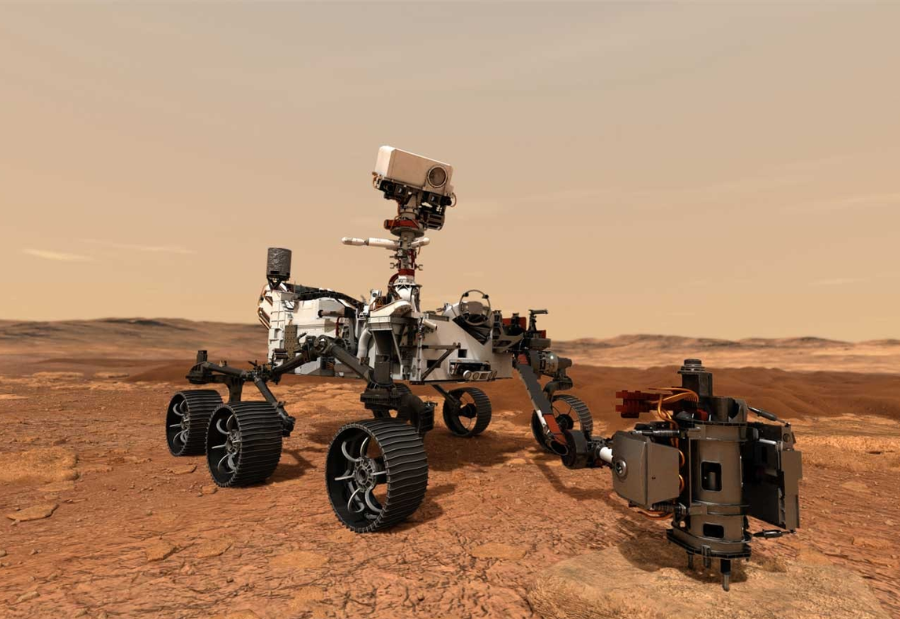
In a significant step toward smarter space exploration, NASA successfully tested AI-generated navigation for its Perseverance rover on Mars. In December, the rover operated without human control for 2 separate days, covering 456 meters (1,496 feet) using AI-created waypoints.
“This demonstration shows how far our capabilities have advanced and broadens how we will explore other worlds,” said NASA Administrator Jared Isaacman.
“Autonomous technologies like this can help missions to operate more efficiently, respond to challenging terrain, and increase science return as distance from Earth grows. It’s a strong example of teams applying new technology carefully and responsibly in real operations.”
Mars is millions of kilometers away, with a 25-minute round-trip communication delay between Earth and the planet. Because of this delay, rovers must often operate independently for short periods. Traditionally, engineers study images and elevation data, then send driving plans with waypoints usually spaced within 100 meters (330 feet). These commands travel through NASA’s Deep Space Network, are relayed via orbiters, and then transmitted to Perseverance.
For this test, AI analyzed orbital images from the Mars Reconnaissance Orbiter’s HiRISE camera along with digital elevation models. Built on Anthropic’s Claude AI, the system identified hazards such as sand traps, boulder fields, bedrock, and rocky outcrops. It then generated a safe path with calculated waypoints. Perseverance’s onboard auto-navigation system executed the drive while processing images and movement plans in motion.
Before deployment, the waypoints were tested on a Perseverance twin called the Vehicle System Test Bed (VSTB) at NASA’s Jet Propulsion Laboratory Mars Yard. Similar engineering models are also used for Curiosity.
“The fundamental elements of generative AI are showing a lot of promise in streamlining the pillars of autonomous navigation for off-planet driving: perception (seeing the rocks and ripples), localization (knowing where we are), and planning and control (deciding and executing the safest path),” said Vandi Verma of JPL.
“We are moving towards a day where generative AI and other smart tools will help our surface rovers handle kilometer-scale drives while minimizing operator workload, and flag interesting surface features for our science team by scouring huge volumes of rover images.”
One major challenge remains: position uncertainty increases the longer the rover drives alone. Currently, humans re-localize the rover through a full Earth-Mars communication cycle. NASA is working on AI-based re-localization by matching orbital and ground-level images.
AI is expected to play a larger role in future missions, including swarm drones on Mars and the Dragonfly rotorcraft mission to Titan.
“Imagine intelligent systems not only on the ground at Earth, but also in edge applications in our rovers, helicopters, drones, and other surface elements trained with the collective wisdom of our NASA engineers, scientists, and astronauts,” said Matt Wallace of JPL.
“That is the game-changing technology we need to establish the infrastructure and systems required for a permanent human presence on the Moon and take the US to Mars and beyond.”
Also read: Viksit Workforce for a Viksit Bharat
Do Follow: The Mainstream formerly known as CIO News LinkedIn Account | The Mainstream formerly known as CIO News Facebook | The Mainstream formerly known as CIO News Youtube | The Mainstream formerly known as CIO News Twitter
About us:
The Mainstream is a premier platform delivering the latest updates and informed perspectives across the technology business and cyber landscape. Built on research-driven, thought leadership and original intellectual property, The Mainstream also curates summits & conferences that convene decision makers to explore how technology reshapes industries and leadership. With a growing presence in India and globally across the Middle East, Africa, ASEAN, the USA, the UK and Australia, The Mainstream carries a vision to bring the latest happenings and insights to 8.2 billion people and to place technology at the centre of conversation for leaders navigating the future.