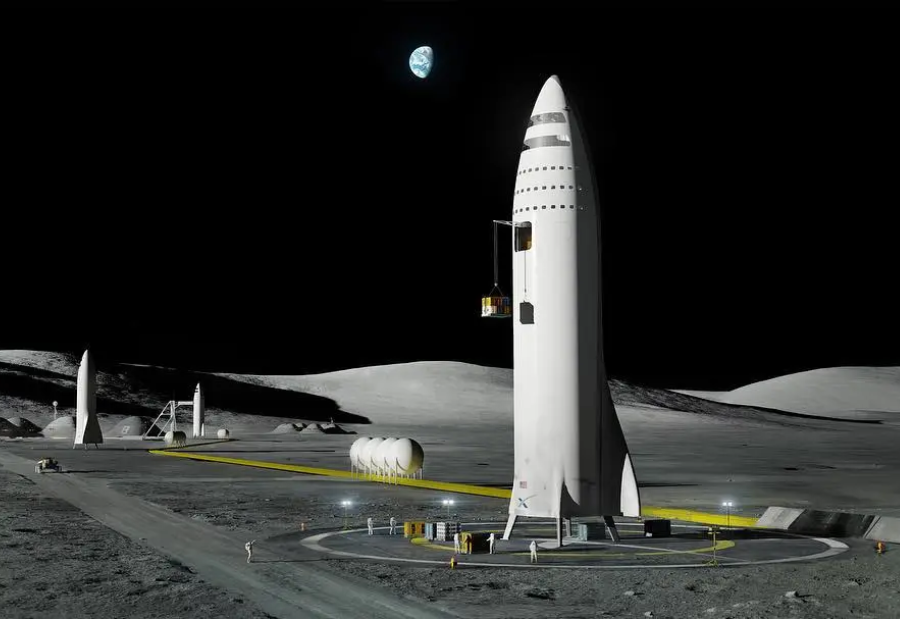
A sweeping new space ambition is now at the center of Elon Musk’s plans for SpaceX and xAI. Following a restructuring at xAI that saw several executives exit, Musk presented a futuristic idea: building a Moonbase Alpha to power the next era of artificial intelligence.
“Join xAI if the idea of mass drivers on the Moon appeals to you,” Musk said, positioning the lunar concept as a recruitment pitch after xAI’s merger with SpaceX and ahead of a potential IPO.
Musk first outlined plans for AI data centers in Earth’s orbit as a key synergy between the 2 companies. He then expanded the idea. “What if you want to go beyond a mere terawatt per year?” he asked. “To do that, you have to go to the moon…I really want to see a mass driver on the moon that is shooting AI satellites into deep space.”
According to Musk, the next step after orbital data centers is building larger computing systems in deep space. His proposal includes constructing a city on the Moon to manufacture space-based computers and launching them into the solar system using a massive maglev-style mass driver.
The concept was shared during an all-hands meeting video released by xAI. The Moonbase slide appeared at the end of the presentation, similar to how Musk previously showcased Mars colonization plans during SpaceX briefings.
Notably, the lunar vision comes after SpaceX publicly stepped back from its long-standing Mars colonization focus. Musk referenced the Kardashev Scale, a theory from the 1960s that ranks civilizations by energy use. He suggested a moon base could harness “maybe even a few percent of the sun’s energy” to train and run AI systems. “It’s difficult to imagine what an intelligence of that scale would think about,” he told employees, “but it’s going to be incredibly exciting to see it happen.”
Mars colonization had long served as a hiring and branding strategy for SpaceX. However, earlier Mars lander plans were dropped in 2017 due to high costs. Since 2016, Starship’s focus has shifted toward launching Starlink satellites and fulfilling $4 billion in NASA contracts to land astronauts on the Moon.
Experts say orbital data centers may become feasible in the 2030s. Building advanced computers on the Moon, however, would require dramatically lower space launch costs and large-scale infrastructure.
Still, the vision marks a dramatic narrative shift. As one departing executive said, “all AI labs are building the exact same thing, and it’s boring.” Musk’s lunar supercomputer plan may be many things, but it is not ordinary.
Also read: Viksit Workforce for a Viksit Bharat
Do Follow: The Mainstream formerly known as CIO News LinkedIn Account | The Mainstream formerly known as CIO News Facebook | The Mainstream formerly known as CIO News Youtube | The Mainstream formerly known as CIO News Twitter
About us:
The Mainstream is a premier platform delivering the latest updates and informed perspectives across the technology business and cyber landscape. Built on research-driven, thought leadership and original intellectual property, The Mainstream also curates summits & conferences that convene decision makers to explore how technology reshapes industries and leadership. With a growing presence in India and globally across the Middle East, Africa, ASEAN, the USA, the UK and Australia, The Mainstream carries a vision to bring the latest happenings and insights to 8.2 billion people and to place technology at the centre of conversation for leaders navigating the future.