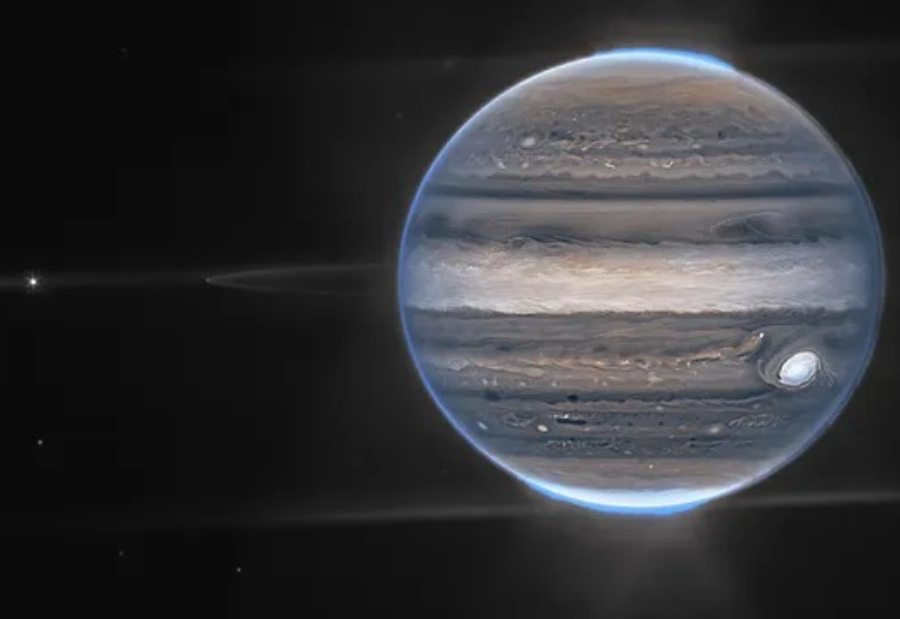
New observations from the James Webb Space Telescope (JWST) have uncovered unusual features in Jupiter’s powerful auroras, showing how the planet’s moons influence the giant planet’s atmosphere and magnetic environment.
Jupiter produces the most intense auroral displays in the solar system. However, scientists have now discovered that its moons can create distinctive “footprints” in these glowing lights by interacting with the planet’s magnetic field.
The findings include the detection of a cold spot in Jupiter’s atmosphere and a sharp rise in the density of charged particles linked to the aurora.
“The moons constantly interact with the magnetic field and plasma surrounding the planet and that interaction leads to highly energetic particles traveling down magnetic field lines and then crashing into the planet’s atmosphere, creating the auroral footprints that map to where the moons orbit around Jupiter,” said Katie Knowles, a PhD researcher at Northumbria University in the U.K.
Auroras on Jupiter form in a similar way to those on Earth. Charged particles carried by the solar wind collide with Jupiter’s magnetic field and are directed toward the planet’s poles. When these particles enter the atmosphere, they strike atoms and molecules, causing them to glow.
Jupiter’s four largest moons — Io, Europa, Ganymede and Callisto — interact with the planet’s magnetic field and leave visible imprints in the aurora.
These effects are strengthened by the Io Plasma Torus. Io, the most volcanic body in the solar system, releases large amounts of charged particles from its volcanoes. These particles spread into space and form a plasma torus around Jupiter, held in place by the planet’s magnetic field.
As the Galilean moons orbit Jupiter, they interact with this plasma torus and magnetic field, pushing ions toward the planet’s atmosphere. This process helps generate electrical currents and contributes to the brightness of the auroral footprints.
In September 2023, researchers Henrik Melin and Tom Stallard from Northumbria University used JWST to capture images of Jupiter’s auroral region as it rotated into view. By observing the edge of the planet, the telescope was able to examine the atmosphere directly beneath the aurora.
JWST captured 5 images during the observation. In 4 of them the aurora appeared normal, but in 1 image scientists detected a cold spot below the aurora linked to Io.
While most of the aurora had a temperature of 919°F (493°C), the cold spot measured about 509°F (265°C).
Scientists also detected a much higher density of ions powering the aurora around this region. One ion, the trihydrogen cation (H3+), was especially abundant. The ion density was about 3 times higher than the rest of the aurora and could vary by up to 45 times within the small region.
“We found extreme variability in both temperature and density within Io’s auroral footprint that happened on the timescale of minutes,” said Knowles. “This tells us that the flow of high-energy electrons crashing into Jupiter’s atmosphere is changing incredibly rapidly.”
Researchers note that similar auroral effects could exist on other planets. For example, Saturn’s moon Enceladus releases particles through water geysers, which may also influence Saturn’s auroras.
“This work opens up entirely new ways of studying not just Jupiter and its other Galilean moons, but potentially other giant planets and their moon systems,” Knowles said.
The research was published on March 3 in the journal Geophysical Research Letters.
Also read: Viksit Workforce for a Viksit Bharat
Do Follow: The Mainstream LinkedIn | The Mainstream Facebook | The Mainstream Youtube | The Mainstream Twitter
About us:
The Mainstream is a premier platform delivering the latest updates and informed perspectives across the technology business and cyber landscape. Built on research-driven, thought leadership and original intellectual property, The Mainstream also curates summits & conferences that convene decision makers to explore how technology reshapes industries and leadership. With a growing presence in India and globally across the Middle East, Africa, ASEAN, the USA, the UK and Australia, The Mainstream carries a vision to bring the latest happenings and insights to 8.2 billion people and to place technology at the centre of conversation for leaders navigating the future.