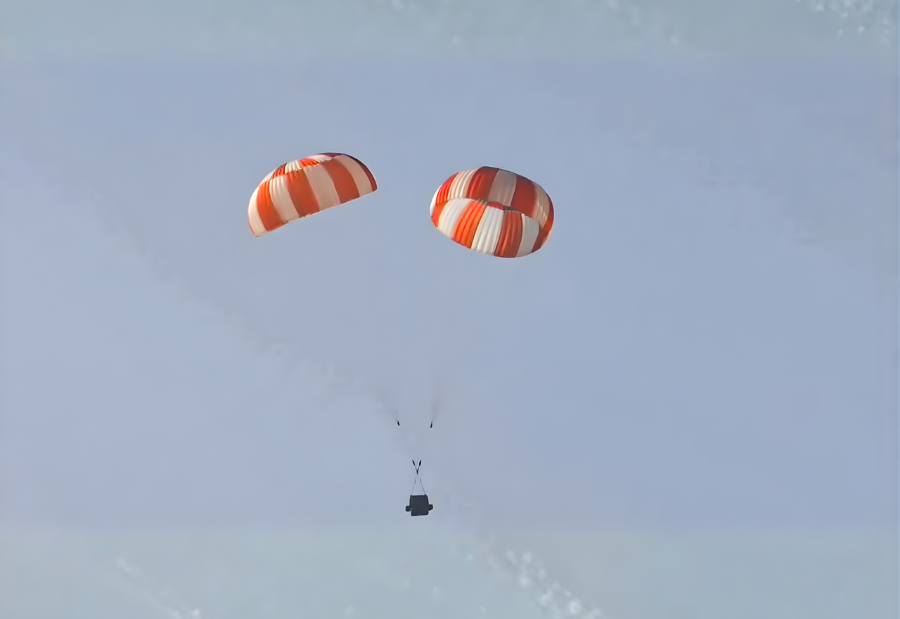
The Indian Space Research Organisation (ISRO) has successfully completed a crucial test of the main parachutes for the Gaganyaan Crew Module (GCM). The test was conducted on 3 November at the Babina Field Firing Range in Jhansi, Uttar Pradesh.
The Gaganyaan mission, India’s first human spaceflight programme, aims to send a three-member crew into space for three days and bring them back safely to Earth. To achieve this, ISRO is developing a human-rated launch vehicle, an orbital module, and a crew escape system. The programme will also include a series of unmanned test missions to verify all key systems before launching the first manned flight.
This test formed part of the ongoing Integrated Main Parachute Airdrop Tests (IMAT) designed to qualify the parachute system for the mission. A simulated mass representing the crew module was dropped from a height of 2.5 kilometres using an Indian Air Force (IAF) IL-76 aircraft.
“The parachute system deployed as planned and the sequence was executed flawlessly, and the test article achieved a stable descent and soft landing, validating the robustness of the parachute design,” ISRO said in its statement.
Earlier in August, ISRO had completed the first Integrated Air Drop Test for the mission at the Satish Dhawan Space Centre in Sriharikota. During that test, the simulated crew module was released from an altitude of about 3 kilometres using an IAF Chinook helicopter, demonstrating the performance of the parachute-based deceleration system.
Explaining the recent test, ISRO stated that the GCM parachute system includes ten parachutes of four different types. “The descent sequence begins with two apex cover separation parachutes that remove the protective cover of the parachute compartment, followed by two drogue parachutes that stabilise and decelerate the module. Upon release of the drogues, three pilot parachutes are deployed to extract three main parachutes, which further slow down the Crew Module to ensure a safe touchdown. The system is designed with redundancy—two of the three main parachutes are sufficient to achieve a safe landing,” ISRO explained.
The test also successfully validated the parachutes under extreme conditions involving a delay in the disreefing process, ensuring that the system maintains stability even in challenging scenarios.
The Vikram Sarabhai Space Centre, Aerial Delivery Research and Development Establishment, DRDO, IAF, and the Indian Army worked together to execute this vital test for India’s human spaceflight ambitions.
Also read: Viksit Workforce for a Viksit Bharat
Do Follow: The Mainstream formerly known as CIO News LinkedIn Account | The Mainstream formerly known as CIO News Facebook | The Mainstream formerly known as CIO News Youtube | The Mainstream formerly known as CIO News Twitter
About us:
The Mainstream formerly known as CIO News is a premier platform dedicated to delivering latest news, updates, and insights from the tech industry. With its strong foundation of intellectual property and thought leadership, the platform is well-positioned to stay ahead of the curve and lead conversations about how technology shapes our world. From its early days as CIO News to its rebranding as The Mainstream on November 28, 2024, it has been expanding its global reach, targeting key markets in the Middle East & Africa, ASEAN, the USA, and the UK. The Mainstream is a vision to put technology at the center of every conversation, inspiring professionals and organizations to embrace the future of tech.