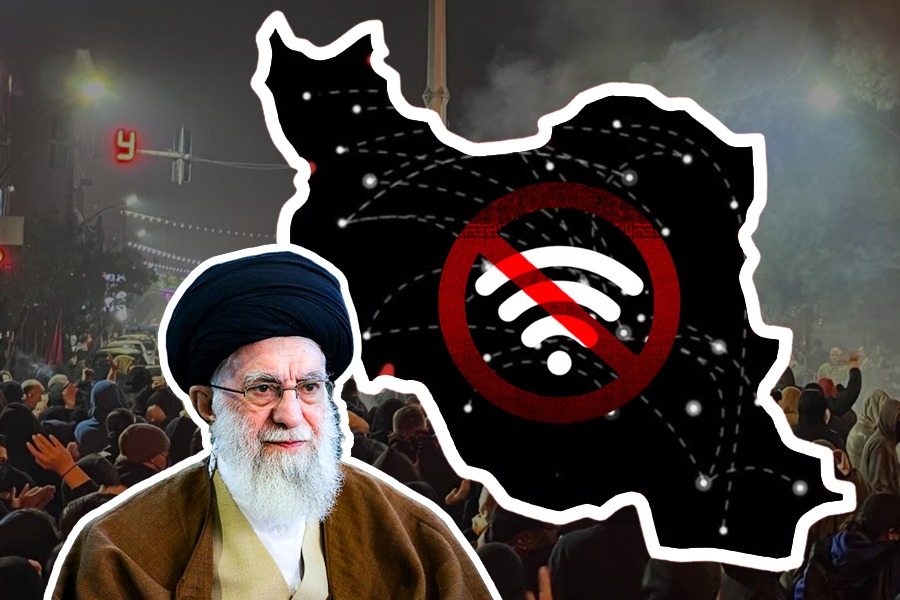
There is nothing subtle about a country disappearing from the internet. One moment it is there, pulsing with messages, markets and movement. The next, it slips out of sight. That is what the ongoing Iran internet blackout feels like.
Not a glitch. Not an outage. A vanishing act.
In Iran, this vanishing has become familiar. Connectivity drops sharply, sometimes to near-zero levels, and with it goes the everyday architecture of modern life. Payments stall. Conversations freeze. The steady hum of updates goes quiet. What remains is not silence, exactly, but something narrower. A world with fewer doors.
This is not the first time. Iran has turned to internet shutdowns before, in 2019, in 2022, in 2025. Each time, the same logic. Reduce internet connectivity, contain the moment, regain control. But repetition has changed the nature of the act. What once felt extraordinary now feels procedural. The Iran internet blackout is no longer a response. It is a reflex.
And that is where it becomes unsettling.
Because this is not about pulling a plug. It is about learning how to dim a system without breaking it. Parts of the network continue to function. Enough to keep things moving internally, not enough to remain fully visible externally. The result is a kind of digital half-light. You are online, but not quite connected.
In the middle of what increasingly feels like a global crisis shaped by conflict and war-like uncertainty, that distinction matters. Information does not just travel. It shapes perception. When connectivity narrows, so does the field of what can be known. Updates slow down. Verification becomes difficult. Rumours stretch further than facts.
The absence of information is not neutral. It tilts the ground.
There is also a cost that is easier to measure. Every Iran internet shutdown hits the economy in real time. Businesses that rely on digital payments pause. Freelancers lose access to work. Services built on constant connectivity begin to falter. Millions of dollars can disappear each day, but the deeper loss is continuity. Systems that depend on being always on do not adapt easily to being switched off.
Yet the strategy persists, which tells you something. Control, at least in the short term, is winning.
The more interesting shift, however, is happening beneath the surface. The internet, once imagined as something open and constant, is being recast as something conditional. Available when permitted, restricted when necessary. The Iran blackout makes that explicit. And people adjust.
They begin to expect disruption. They download instead of streaming. They message faster, just in case. They build habits around uncertainty. Over time, the internet stops feeling like a space you live in and starts feeling like a space you visit, when allowed.
That is not a technical change. It is a psychological one.
The metaphor here is not of a switch, but of a horizon that keeps moving closer. The world is still there, but you can see less of it. And once you get used to that smaller view, it begins to feel normal. The Iran internet blackout is not just about connectivity dropping. It is about expectations shrinking.
In a moment shaped by crisis and tension, that may be the most powerful shift of all.
Also read: Viksit Workforce for a Viksit Bharat
Do Follow: The Mainstream LinkedIn | The Mainstream Facebook | The Mainstream Youtube | The Mainstream Twitter
About us:
The Mainstream is a premier platform delivering the latest updates and informed perspectives across the technology business and cyber landscape. Built on research-driven, thought leadership and original intellectual property, The Mainstream also curates summits & conferences that convene decision makers to explore how technology reshapes industries and leadership. With a growing presence in India and globally across the Middle East, Africa, ASEAN, the USA, the UK and Australia, The Mainstream carries a vision to bring the latest happenings and insights to 8.2 billion people and to place technology at the centre of conversation for leaders navigating the future.