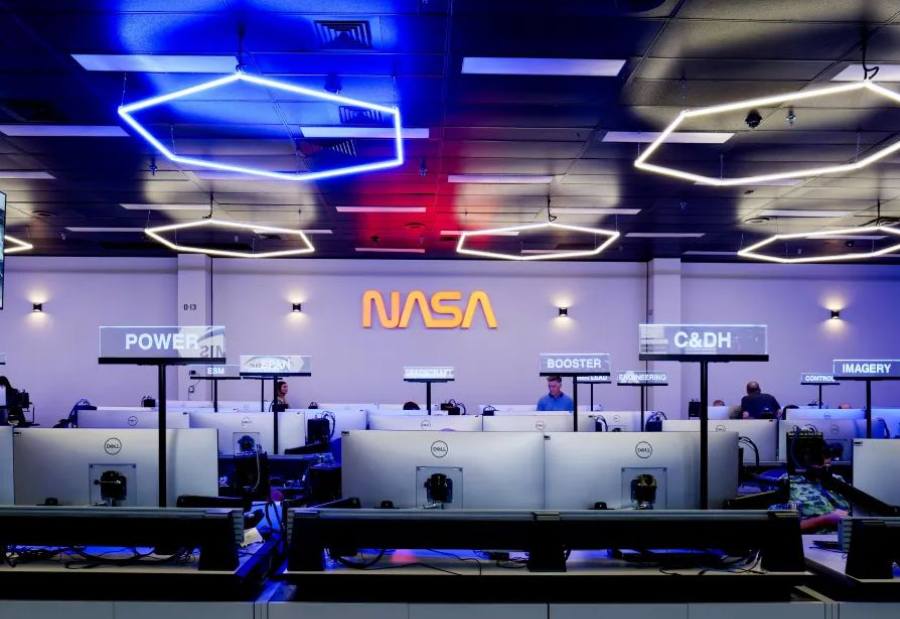
At the heart of NASA’s return to the Moon lies a historic control room in Houston, where every second of the Artemis II mission will be monitored, managed, and guided from Earth.
Located at the Christopher C Kraft, Jr Mission Control Center, this facility continues a legacy that began during the Apollo era. While the original control room is now preserved as a US National Historic Landmark, the modern Artemis mission control sits just across the hall—updated with advanced systems but built on the same core principles.
Artemis II, currently scheduled for April 2026, will send 4 astronauts on a 10-day journey looping beyond the Moon. It will mark the first crewed lunar mission since 1972, using NASA’s SLS rocket and Orion spacecraft.
From Houston, mission control teams will operate 24/7 in 3 shifts, overseeing everything from trajectory and propulsion to astronaut health. “The role of mission control is ultimately to keep the astronauts safe, keep the Orion spacecraft safe and to achieve the mission objectives,” said Fiona Antkowiak, one of the flight directors for Artemis II.
While technology has evolved—from bulky consoles to touchscreens—the structure remains the same. A flight director leads operations, supported by specialised roles such as life support engineers, still referred to as Eecom, a title dating back to early space missions.
The control room today reflects a more diverse workforce, moving beyond the male-dominated teams of the Apollo era. Leadership roles are now frequently held by women, and workplace culture has become more inclusive and informal.
Beyond mission control, another critical team operates from the Orion Mission Evaluation Room (Mer). These engineers, many of whom helped design the spacecraft, analyse performance in depth and resolve complex issues. “We know the most about the spacecraft,” said Trey Perryman, Orion Mer Lead.
Preparation remains intense. Teams simulate multiple failures to build readiness. “Our goal is that we run a simulation, and 10 things break in 3 hours,” Antkowiak said, highlighting the focus on handling worst-case scenarios.
A key moment in the mission will come 2 days after launch, when controllers decide whether to proceed with “translunar injection”—sending Orion towards the Moon. Once approved, there are limited options to return quickly.
Another challenge will be a 40-minute communication blackout as the spacecraft passes behind the Moon, a tense period for teams awaiting signal return.
As Artemis II prepares for launch, mission control stands ready—combining decades of experience with modern technology to guide humanity’s next step into deep space.
Also read: Viksit Workforce for a Viksit Bharat
Do Follow: The Mainstream LinkedIn | The Mainstream Facebook | The Mainstream Youtube | The Mainstream Twitter
About us:
The Mainstream is a premier platform delivering the latest updates and informed perspectives across the technology business and cyber landscape. Built on research-driven, thought leadership and original intellectual property, The Mainstream also curates summits & conferences that convene decision makers to explore how technology reshapes industries and leadership. With a growing presence in India and globally across the Middle East, Africa, ASEAN, the USA, the UK and Australia, The Mainstream carries a vision to bring the latest happenings and insights to 8.2 billion people and to place technology at the centre of conversation for leaders navigating the future.