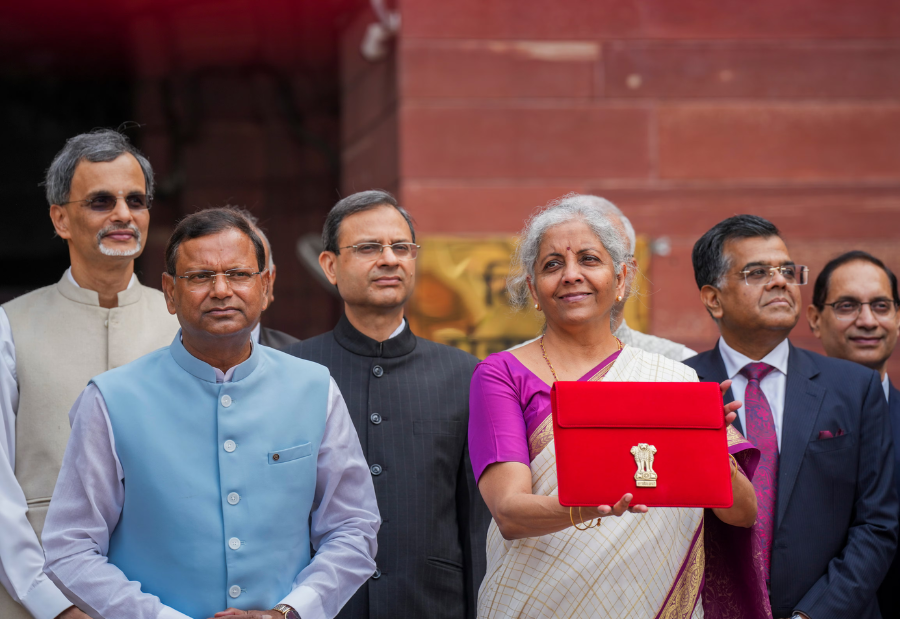
With the Union Budget due this Sunday, India’s economy looks strong on the surface, but deeper pressures are becoming harder to ignore.
The country is set to close the financial year with growth of 7.3%, cross $4 trillion in GDP, and overtake Japan as Asia’s second-largest economy. Retail inflation is below 2% and is expected to stay under the Reserve Bank of India (RBI)’s target. Farm output has been solid, cereal production is high, and food stocks are healthy, supporting rural incomes. Tax cuts and GST reforms last year have also lifted consumption. The central bank has called this mix of high growth and low inflation a “Goldilocks” phase.
Yet the headline figures mask key weaknesses. Official data shows unemployment falling, but demand for gig work remains high. India’s 5 largest IT firms added only 17 net jobs in the first 9 months of 2025, pointing to stress in white-collar hiring. The slowdown reflects disruption from AI in the back-office economy and continued pressure on labour-heavy export sectors.
Trade is another concern. India has entered 2026 under the impact of 50% US tariffs. Although the government has signed several free trade agreements, including one with the European Union this week, exports remain weak. “Exports to the US weakened sequentially since the implementation of the 50% US tariff, while to the rest of the world it has picked up only marginally,” said HSBC Research. Analysts note that success in new markets depends on price, quality, and scale, especially against rivals like Vietnam and Bangladesh.
Private investment remains a long-term worry. JP Morgan’s Jehangir Aziz said corporate investment has “flatlined since 2012” at around 12% of GDP. Weak demand and excess factory capacity have limited new projects. Ruchir Sharma of Rockefeller International wrote in a recent article for a newspaper that foreign direct investment never rose above 1.5% of GDP in India and is now just 0.1%.
The government recently updated labour codes to improve the business climate, but results are uncertain. Economists expect the budget to focus on reforms and fiscal discipline. Possible steps include expanding production-linked incentives and supporting MSMEs and exporters. Infrastructure spending of over $100 billion a year is likely to continue, with capital outlay near 3% of GDP. However, tax cuts worth 0.9% of GDP last year may widen deficits. “A big stimulus is unlikely,” said Nuvama Securities, noting a target to cut the debt-to-GDP ratio by 1% annually until FY31.
Also read: Viksit Workforce for a Viksit Bharat
Do Follow: The Mainstream formerly known as CIO News LinkedIn Account | The Mainstream formerly known as CIO News Facebook | The Mainstream formerly known as CIO News Youtube | The Mainstream formerly known as CIO News Twitter
About us:
The Mainstream is a premier platform delivering the latest updates and informed perspectives across the technology business and cyber landscape. Built on research-driven, thought leadership and original intellectual property, The Mainstream also curates summits & conferences that convene decision makers to explore how technology reshapes industries and leadership. With a growing presence in India and globally across the Middle East, Africa, ASEAN, the USA, the UK and Australia, The Mainstream carries a vision to bring the latest happenings and insights to 8.2 billion people and to place technology at the centre of conversation for leaders navigating the future.