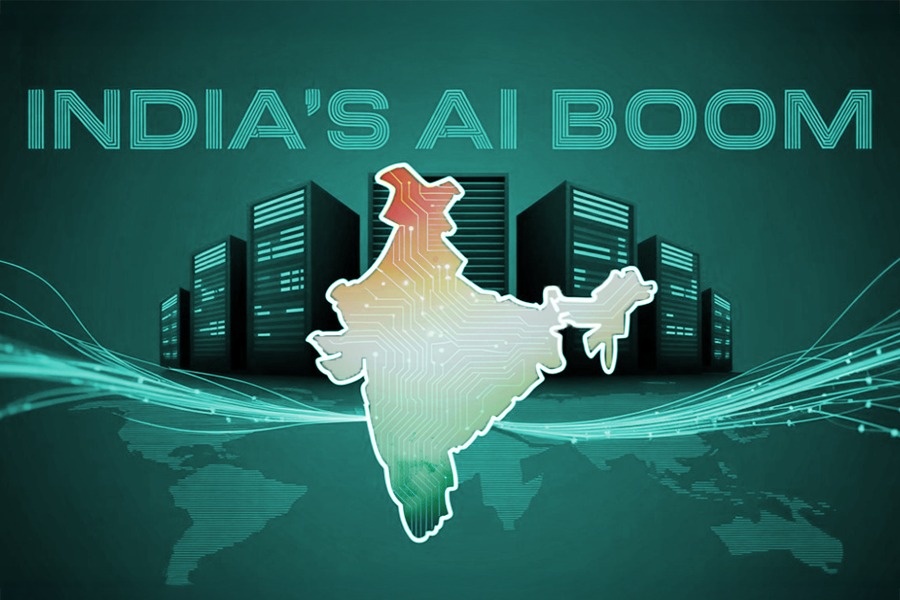
As the India AI Impact Summit 2026 continues in New Delhi until February 21, India has unmistakably signalled its ambition: it does not intend to merely consume artificial intelligence — it wants to help shape it. Ministers have spoken of sovereign compute, responsible AI, multilingual models and public digital infrastructure 2.0. The tone is confident, the participation global, the intent strategic.
The numbers support the seriousness. India’s AI market, estimated at under $3 billion in 2020, has crossed $7 billion and is projected to grow exponentially over the next decade, with forecasts placing it above $100 billion by the early 2030s. Global AI vibrancy rankings now place India third after the United States and China. Under the IndiaAI Mission, the government has committed ₹10,000 crore (around $1.2 billion) to build compute infrastructure, support startups, develop public datasets and strengthen skilling pipelines. Plans to expand domestic GPU capacity signal recognition that in the AI age, compute is as strategic as oil once was.
And yet, ambition and allocation are not architecture.
Nearly half of large Indian enterprises report AI use cases in production, according to industry surveys. Indian knowledge workers are among the most active users of generative AI globally. But enterprise enthusiasm coexists with structural gaps — uneven access to high-performance computing for research institutions, fragmented data across ministries and states, procurement bottlenecks that slow public adoption, and a shortage of deeply specialised AI researchers.
India has faced this test before. The country’s digital public infrastructure success did not emerge from conferences alone. It was built through interoperable standards, institutional stewardship and policy continuity. AI, far more complex and far more consequential, demands similar discipline. Without shared data frameworks, audit mechanisms and liability clarity, AI systems risk scaling opacity as efficiently as they scale efficiency.
The Summit’s emphasis on responsible AI and inclusion is welcome. But governance cannot remain declarative. As AI begins influencing credit decisions, welfare targeting, hiring systems and public information flows, accountability must be embedded early — not retrofitted after missteps.
This is where the India AI Impact Summit 2026 will ultimately be judged. Not by the scale of its exhibition halls or the breadth of its global attendance, but by what follows: transparent access to compute for researchers, interoperable public datasets, sustained research funding, and regulatory clarity that balances innovation with public trust.
India’s AI moment is real. The investment is significant. The opportunity is historic. The question is whether this moment produces systems or simply statements.
In technology, history tends to favour the countries that build quietly, consistently and structurally. The summit will conclude, the delegations will depart, and the headlines will move on. What endures and what will define this chapter is whether the intent displayed here matures into systems that quietly, consistently deliver.
Also read: Viksit Workforce for a Viksit Bharat
Do Follow: The Mainstream formerly known as CIO News LinkedIn Account | The Mainstream formerly known as CIO News Facebook | The Mainstream formerly known as CIO News Youtube | The Mainstream formerly known as CIO News Twitter
About us:
The Mainstream is a premier platform delivering the latest updates and informed perspectives across the technology business and cyber landscape. Built on research-driven, thought leadership and original intellectual property, The Mainstream also curates summits & conferences that convene decision makers to explore how technology reshapes industries and leadership. With a growing presence in India and globally across the Middle East, Africa, ASEAN, the USA, the UK and Australia, The Mainstream carries a vision to bring the latest happenings and insights to 8.2 billion people and to place technology at the centre of conversation for leaders navigating the future.