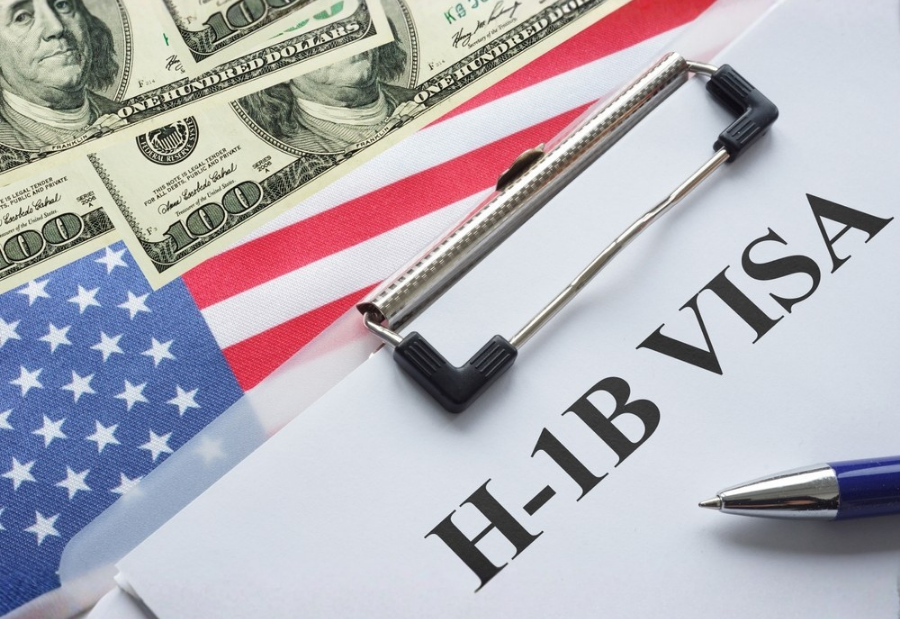
Major changes are coming to the U.S. H-1B visa program, with employers expected to face a sharp rise in wage costs as the country moves to a wage-based selection system from February 2026.
Under the revised rules, the H-1B lottery will shift from a random draw to a weighted selection process that prioritizes higher-paid roles. This change is expected to reduce opportunities for lower-paid, entry-level workers while increasing demand for senior and highly skilled professionals. As a result, U.S. employers will see a significant increase in their total wage bill.
The new framework uses a 4-level wage system based on experience and job complexity. Wage level I applies to entry-level workers, level II to experienced workers, level III to fully competent professionals, and level IV to expert or senior-level professionals.
Under the updated selection method, registrations assigned wage level IV will be entered into the lottery 4 times. Wage level III registrations will be entered 3 times, level II registrations 2 times, and level I registrations only once. This weighting sharply reduces the chances for lower-paid workers, with estimates showing a 48% drop in selection odds for wage level I applicants.
The wage impact is substantial. Based on FY 2024 data, the average annual salary for H-1B workers was $85,006 at wage level I, $103,071 at level II, $131,454 at level III, and $162,528 at level IV.
Under the current system, the total annual salary paid to H-1B cap-subject workers stood at $8,862,595,799, or $8.8 billion. With the weighted selection process, this figure is projected to rise as more higher-paid workers are selected.
The Department of Homeland Security estimates that total annual H-1B wages will increase by $502,080,486, taking the total to $9,364,676,285, or $9.4 billion, in the first year alone. This $502 million increase is considered a quantifiable economic benefit of the final rule.
Since the initial H-1B stay is granted for 3 years, with extensions up to another 3 years, DHS used an average stay of 5 years for its calculations. From year 5 onward, the accrued benefits are estimated at $2,510 million annually.
The new system also leads to a major redistribution of income. DHS estimates that $858 million will shift from wage level I workers to higher wage levels in the first year. From year 5 onward, these transfers are expected to reach about $4,292 million annually.
Also read: Viksit Workforce for a Viksit Bharat
Do Follow: The Mainstream formerly known as CIO News LinkedIn Account | The Mainstream formerly known as CIO News Facebook | The Mainstream formerly known as CIO News Youtube | The Mainstream formerly known as CIO News Twitter
About us:
The Mainstream is a premier platform delivering the latest updates and informed perspectives across the technology business and cyber landscape. Built on research-driven, thought leadership and original intellectual property, The Mainstream also curates summits & conferences that convene decision makers to explore how technology reshapes industries and leadership. With a growing presence in India and globally across the Middle East, Africa, ASEAN, the USA, the UK and Australia, The Mainstream carries a vision to bring the latest happenings and insights to 8.2 billion people and to place technology at the centre of conversation for leaders navigating the future.