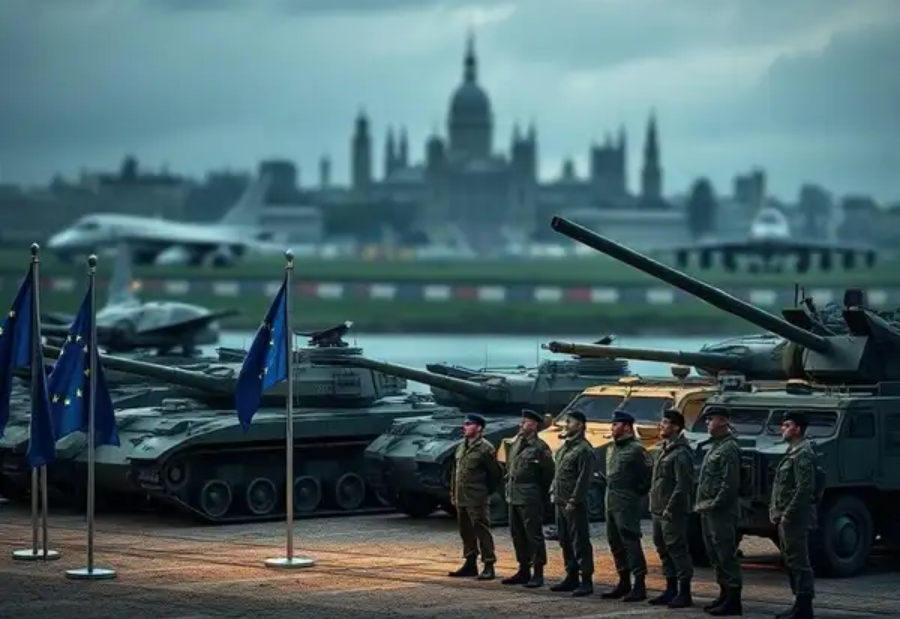
Several defence technology start-ups across Europe are preparing to raise new funding this year as companies accelerate efforts to develop and scale advanced weapons and defence systems for the region’s armed forces.
Among the firms announcing recent financing activity are Frankenburg Technologies, an Estonian start-up building low-cost AI-powered anti-drone missile systems, along with German companies Tytan Technologies and Quantum Systems.
Investment in Europe’s defence tech sector reached a record $9 bn in 2025, marking a strong year for capital raising among start-ups developing military and security technologies. Ongoing geopolitical tensions, including the latest conflict in the Middle East, have further highlighted the need for faster and more affordable defence systems, an area where many start-ups are focusing their innovation.
Despite the surge in investment, industry leaders say a key priority now is securing more funding from European sources, as many companies still depend heavily on US investors.
“The most important task of this generation in Europe is to rebuild defence readiness and deterrence in Europe . . . The only capital inherently interested in preserving freedom and prosperity in Europe is European capital,” said Kusti Salm, chief executive of Frankenburg Technologies.
Over the past 3 years, North American investors have played an increasing role in funding European defence start-ups, accounting for more than one-third of the capital raised last year.
However, Europe still lags significantly behind the United States in defence technology investment. According to research by Boston Consulting Group, venture capital funding directed toward defence in the past decade has been 8.5 times larger in the US than in Europe.
Industry experts say the gap highlights the need for stronger European investment support if the region hopes to build scalable defence technology companies.
Sten Tamkivi, partner at venture capital firm Plural, said the investment landscape is slowly evolving, with more funds being dedicated to defence technologies. Frankenburg is currently developing affordable air defence systems and plans to establish 2 mass-production sites within the EU.
However, he noted that while raising smaller amounts of capital is relatively easy, securing €50 mn to €200 mn from European private investors remains extremely difficult.
“That is where the market issue today is, how can Europe fund this ambition and growth beyond tens of millions of euros? Getting to that requires more pension funds and large capital pools,” Tamkivi said.
Executives at Quantum Systems and drone start-up Helsing also acknowledged the sector’s ongoing reliance on US capital.
Last month, Quantum Systems, a surveillance drone company, secured €150 mn in long-term debt financing backed by the European Investment Bank (EIB) and major European commercial lenders. The company is supported by European funds including Project A, HV Capital and Balderton Capital, but also counts US investor Peter Thiel among its early backers.
Quantum co-founder Florian Seibel said Thiel supported the company in 2019 “against all odds.” He added that as the company explores the scale needed to build a $100 bn business, it may still need US investors for future funding rounds because such large investments are difficult to raise within Europe alone.
Meanwhile, Gundbert Scherf, co-founder and co-chief executive of Helsing, pointed out that ethical concerns among investors continue to limit funding for companies focused solely on military technologies.
“On the capital side, if we had easier access to just European capital, I think it’d be great to build more scaled companies, sovereign entities.”
Many European financial institutions still require defence technologies to have dual-use applications rather than being designed exclusively for military purposes.
Adam Niewiński, co-founder of Polish venture capital firm OTB Ventures, said reputational concerns also influence investment decisions, particularly in sectors involving weapons or explosives.
“In terms of reputation it is easier to not have anything to do with aggressive warfare and to explain why we are investing in something that is truly defensive, like a producer of kinetic drone interceptors, rather than something that is actually made to kill people,” he said.
Despite these challenges, experts say institutional funding support is gradually increasing.
Nadia Calviño, president of the EIB, said the bank’s €70 mn loan, part of Quantum’s €150 mn financing package, helped act as a “catalyser” by attracting additional private investment.
The European Investment Fund (EIF) has also committed €50 mn to a new fund being raised by venture capital firm Join Capital, which aims to raise €235 mn to support 25 early-stage defence technology start-ups.
Fiona Murray, chair of the Nato Innovation Fund, said Europe is starting to see larger funds dedicated to defence technology. However, she emphasized the importance of stronger coordination among European countries.
“If every country was trying to build its own 30 companies, they’d all be a bit sub-scale because no one of them could be big enough.”
Industry leaders also warn that funding alone will not be enough. Governments are still allocating most defence spending to large established defence contractors rather than innovative start-ups.
At last month’s Munich Security Conference, senior officials pledged stronger support for defence technology start-ups following criticism of heavy spending on traditional weapons systems.
A recent report by think-tank Bruegel found that defence procurement in several European countries is still heavily concentrated among the 10 largest defence companies, with less than 30% of total orders typically going to smaller firms.
Guntram Wolff, senior fellow at Bruegel and one of the report’s authors, said start-ups need early government contracts to unlock further investment.
He noted that once companies secure an initial €10 mn defence contract, they can often raise €100 mn from investors, as the contract signals credibility and market demand.
Also read: Viksit Workforce for a Viksit Bharat
Do Follow: The Mainstream LinkedIn | The Mainstream Facebook | The Mainstream Youtube | The Mainstream Twitter
About us:
The Mainstream is a premier platform delivering the latest updates and informed perspectives across the technology business and cyber landscape. Built on research-driven, thought leadership and original intellectual property, The Mainstream also curates summits & conferences that convene decision makers to explore how technology reshapes industries and leadership. With a growing presence in India and globally across the Middle East, Africa, ASEAN, the USA, the UK and Australia, The Mainstream carries a vision to bring the latest happenings and insights to 8.2 billion people and to place technology at the centre of conversation for leaders navigating the future.