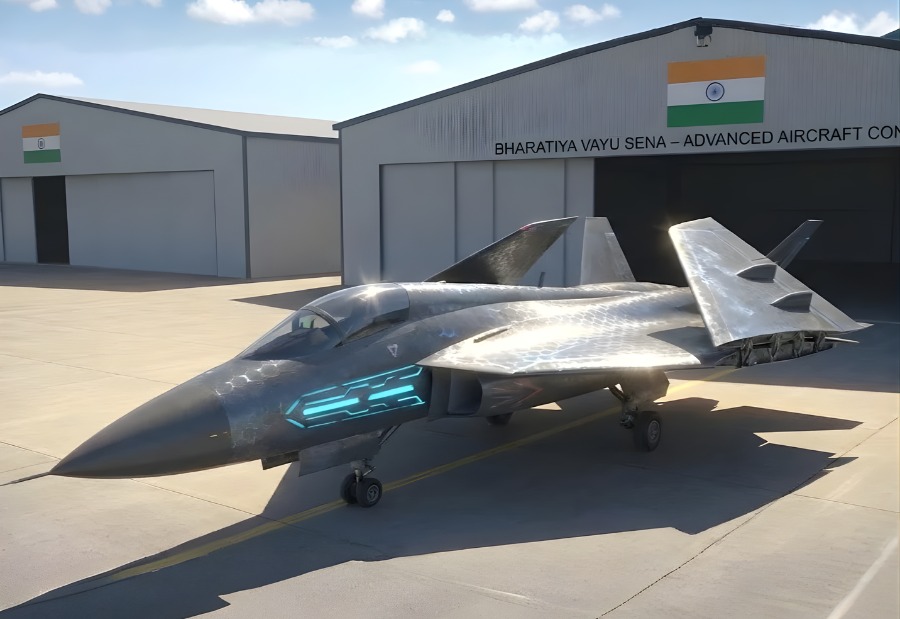
India’s Defence Research and Development Organisation is preparing a major research programme focused on technologies for sixth generation fighter jets. The initiative aims to move beyond current fifth generation standards and develop advanced capabilities such as shape shifting wings, self repairing stealth coatings and photonic flight control systems. These technologies are expected to support India’s air power in the years after the rollout of the Advanced Medium Combat Aircraft.
Senior officials have said that while the immediate priority remains the AMCA, which is targeted for prototype development in 2028, long term planning has begun for aircraft expected to operate after 2040. The goal is to prepare the Indian Air Force for future threats across sensitive regions including the Himalayan borders and the Indian Ocean Region. Although the technologies are still at an early stage and unlikely to be ready within the next decade, the organisation believes consistent investment is essential. This approach places India among global aviation powers that are exploring adaptive structures and blended wing concepts.
A key element of the research is wing morphing. This concept allows an aircraft to change the shape of its wings during flight, similar to how birds adjust their feathers. The system removes the need for rigid control surfaces. Defence analysts say this could improve fuel efficiency, reduce radar visibility and offer better manoeuvrability. The organisation has already demonstrated an early version of this idea in 2022 with a wing capable of changing its curvature, which was successfully tested in a wind tunnel.
Another area of development is nano based stealth coatings. These coatings are created with atom thin metamaterials that are lighter and more durable than traditional radar absorbent materials. They can be tuned with electric fields to manage electromagnetic waves, reduce heat signatures and soften engine noise. The coatings also have self healing abilities, allowing them to repair minor surface damage and maintain their stealth characteristics. This is seen as an important counter to advanced detection systems being developed by neighbouring countries.
The agency is also working on a shift from fly by wire to fly by light systems. This system uses fibre optic cables instead of electrical wiring to send signals between the pilot and the flight computer. Light based transmission provides much faster speeds, greater bandwidth and strong resistance to interference. It can also reduce aircraft weight by replacing heavy copper wiring.
This research plan marks an important step in India’s attempt to become a leader in aerospace innovation and reduce reliance on foreign defence technology.
Also read: Viksit Workforce for a Viksit Bharat
Do Follow: The Mainstream formerly known as CIO News LinkedIn Account | The Mainstream formerly known as CIO News Facebook | The Mainstream formerly known as CIO News Youtube | The Mainstream formerly known as CIO News Twitter
About us:
The Mainstream is a premier platform delivering the latest updates and informed perspectives across the technology business and cyber landscape. Built on research-driven, thought leadership and original intellectual property, The Mainstream also curates summits & conferences that convene decision makers to explore how technology reshapes industries and leadership. With a growing presence in India and globally across the Middle East, Africa, ASEAN, the USA, the UK and Australia, The Mainstream carries a vision to bring the latest happenings and insights to 8.2 billion people and to place technology at the centre of conversation for leaders navigating the future.