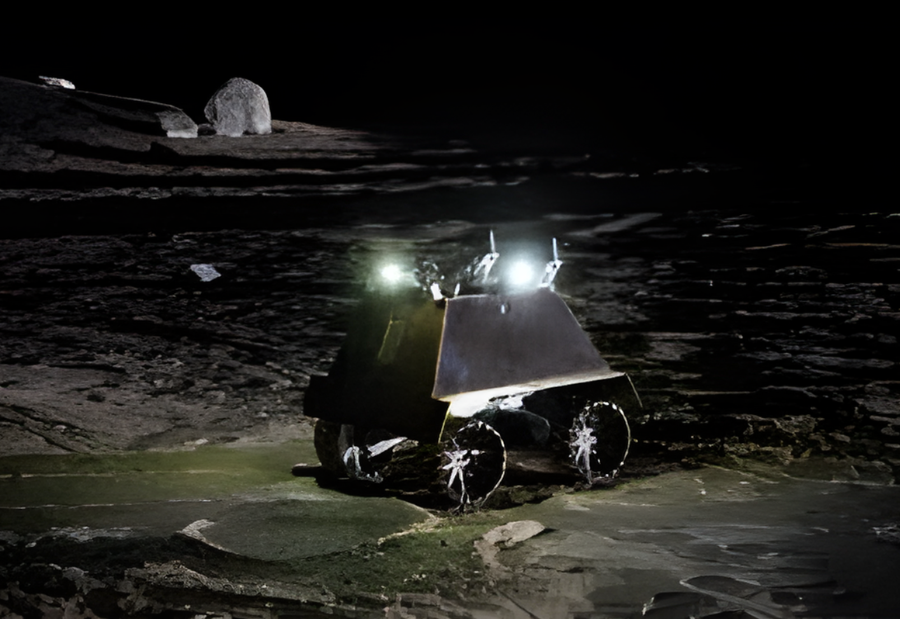
Chinese engineers are designing a dexterous wheeled robot that could assist with construction, maintenance, and research activities on the Moon as part of the country’s plans to establish a lunar research station by 2035.
The concept has been developed by researchers from the Beijing Institute of Spacecraft System Engineering. The robot combines wheeled mobility with humanoid-style dexterity, allowing it to travel efficiently across the lunar surface while performing a wide range of complex tasks.
According to researchers, the machine is designed to support construction work, equipment maintenance, scientific experiments, and the collection and analysis of lunar samples. Details of the concept and its capabilities were published in the Journal of Deep Space Exploration.
Flexible mechanical design
The robot is built to offer both flexibility and precision in challenging lunar environments. Its waist can rotate nearly 180° in either direction and bend forward up to 90°, enabling it to reach tools and perform tasks more effectively.
The robot also features an articulated hand with 4 degrees of freedom, allowing it to manipulate instruments and objects with greater accuracy.
Wheeled mobility for lunar terrain
Researchers believe that wheeled locomotion could offer major advantages for operations on the Moon. An active suspension system mounted on wheels allows the robot to move faster and remain more stable than traditional bipedal robots.
This design provides a steady base for the robot’s upper body while performing technical tasks.
China has previously relied on wheeled systems in its planetary missions, including the Yutu lunar rovers and the Zhurong rover on Mars. For the lunar robot, engineers are considering lightweight metal mesh wheels reinforced with steel-wire treads, which can provide durability, flexibility, and shock absorption on rugged terrain.
This structure would help the robot maintain traction and travel long distances across the Moon’s surface while operating in extreme temperatures.
Role in future lunar base
Humanoid-style robots have long been viewed as valuable assistants for astronauts in space missions. One early example is Robonaut, developed by NASA and General Motors, which became the first humanoid robot sent to the International Space Station in 2011.
China is now advancing its own plans for a permanent lunar presence. In 2021, the country proposed the International Lunar Research Station, a multinational project planned near the Moon’s south pole. The facility is expected to operate largely with robotic systems, while astronauts would visit for shorter missions.
As part of these preparations, China is planning the Chang’e-7 mission, scheduled for launch later this year. The mission will study potential water ice deposits in permanently shadowed craters near the lunar south pole.
Researchers have also proposed another robotic system for logistics. This design features a six-legged platform capable of performing a soft landing on the Moon before walking across the surface to transport cargo. Together, these robotic systems could play a key role in constructing and supporting China’s future lunar research station.
Also read: Viksit Workforce for a Viksit Bharat
Do Follow: The Mainstream LinkedIn | The Mainstream Facebook | The Mainstream Youtube | The Mainstream Twitter
About us:
The Mainstream is a premier platform delivering the latest updates and informed perspectives across the technology business and cyber landscape. Built on research-driven, thought leadership and original intellectual property, The Mainstream also curates summits & conferences that convene decision makers to explore how technology reshapes industries and leadership. With a growing presence in India and globally across the Middle East, Africa, ASEAN, the USA, the UK and Australia, The Mainstream carries a vision to bring the latest happenings and insights to 8.2 billion people and to place technology at the centre of conversation for leaders navigating the future.