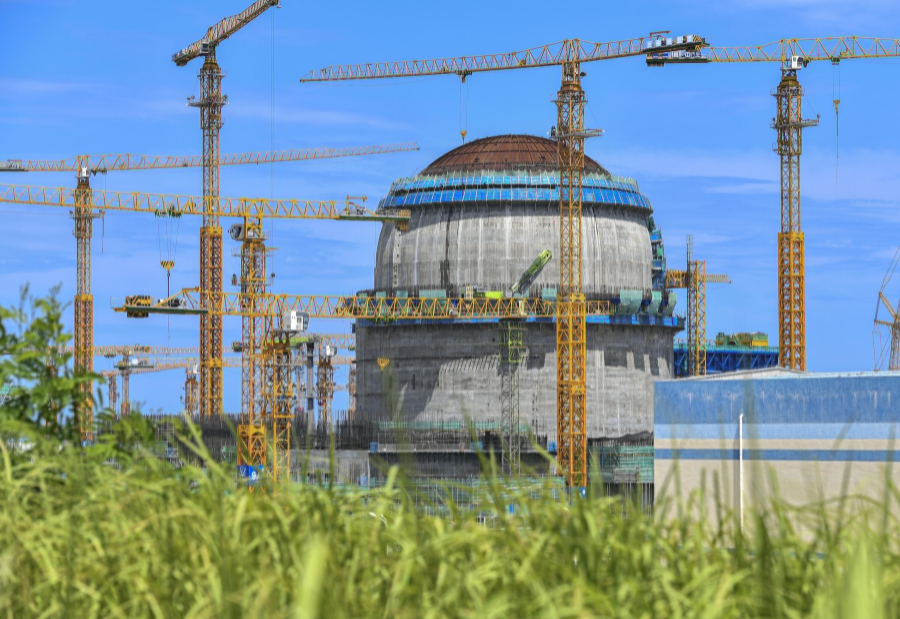
Marking a major shift in how nuclear energy is used, China has started construction of the Xuwei Nuclear Heating and Power Plant in Jiangsu Province, a project described as the world’s first large-scale facility designed to directly supply nuclear energy to the petrochemical industry.
The milestone was marked by the pouring of first concrete for Unit 1, signalling China’s move beyond conventional electricity-only nuclear plants. The Xuwei facility is intended to act as a large clean-energy source for heavy chemical manufacturing, one of the most carbon-intensive industrial sectors globally.
The project is being developed by China National Nuclear Corporation and is the first nuclear power unit to break ground under China’s 15th Five-Year Plan. It reflects a broader strategy to expand nuclear energy into industrial heating and power co-generation.
Hybrid nuclear design for industrial steam
Unlike traditional nuclear plants, Xuwei features a hybrid design that combines 2 generations of reactor technology to meet the extreme heat demands of petrochemical processing.
The setup integrates the Hualong One, a third-generation pressurized water reactor, with a fourth-generation high-temperature gas-cooled reactor. The Hualong One units generate saturated steam from demineralized water, while the high-temperature gas-cooled reactor further heats the steam to the levels required for chemical cracking and distillation.
The plant is located next to the Lianyungang petrochemical hub, which consumes about 13,000 tonnes of steam per hour. By replacing coal-fired steam with nuclear-generated steam, the project sharply reduces environmental impact.
Once the first phase becomes operational, the facility is expected to supply 32.5 million tons of industrial steam each year and generate more than 11.5 billion kWh of electricity. This would save an estimated 7.26 million tons of standard coal annually and cut carbon dioxide emissions by about 19.6 million tons per year.
According to project data, nuclear-generated steam is roughly 600 times cleaner than coal-based steam and 100 times cleaner than steam produced from natural gas.
Advanced digital control and automation
To manage the complexity of operating 2 different reactor types together, the project team used hierarchical digital simulations to design the control logic. Construction is also being accelerated through intelligent automation, including laser-guided tracking for automated welding and robotic Metal Active Gas systems, which are reported to be 3 times more efficient than manual welding.
As the first nuclear project launched under the current Five-Year Plan, Xuwei is intended to serve as a model for future developments. CNNC views the project as a blueprint for industrial decarbonization.
“It opens a new chapter in providing a replicable and scalable “Chinese solution” for the low-carbon transformation of high-energy-consuming industries worldwide, injecting strong momentum into the realization of global carbon peaking and carbon neutrality goals,” sources reported.
Also read: Viksit Workforce for a Viksit Bharat
Do Follow: The Mainstream formerly known as CIO News LinkedIn Account | The Mainstream formerly known as CIO News Facebook | The Mainstream formerly known as CIO News Youtube | The Mainstream formerly known as CIO News Twitter
About us:
The Mainstream is a premier platform delivering the latest updates and informed perspectives across the technology business and cyber landscape. Built on research-driven, thought leadership and original intellectual property, The Mainstream also curates summits & conferences that convene decision makers to explore how technology reshapes industries and leadership. With a growing presence in India and globally across the Middle East, Africa, ASEAN, the USA, the UK and Australia, The Mainstream carries a vision to bring the latest happenings and insights to 8.2 billion people and to place technology at the centre of conversation for leaders navigating the future.