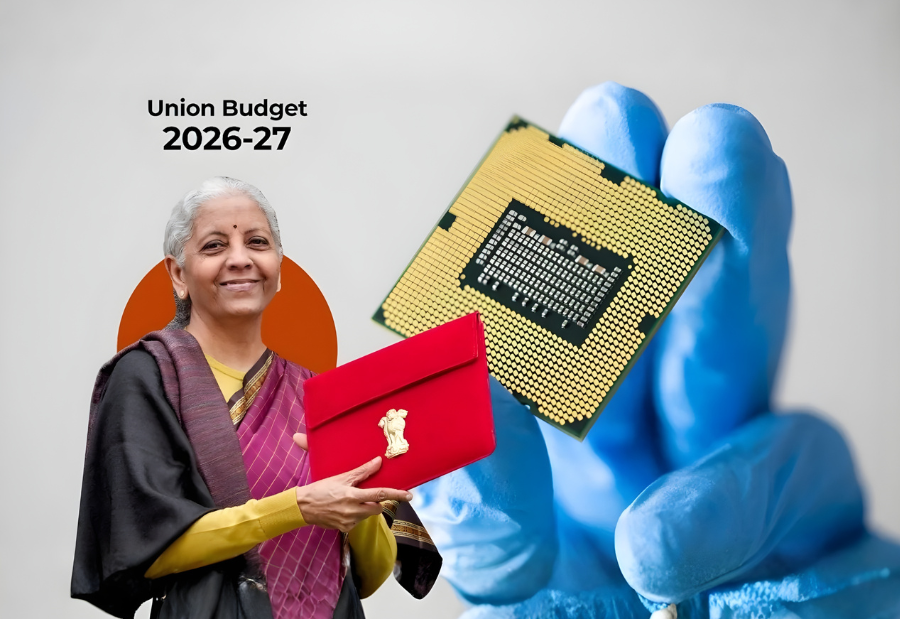
The Union Budget 2026-27 details proposals ranging from the Semiconductor Mission 2.0 and tax breaks for cloud services to new AI tools for farmers and ports.
Finance Minister Nirmala Sitharaman laid out the government’s push to scale up manufacturing across seven strategic and frontier sectors, including semiconductors and electronics manufacturing, as presented in the Union Budget 2026-27 Sunday.
The Budget comes against the backdrop of a realignment of the global economic order, as trade wars, tariff regimes, supply-chain fragmentation, and rising geopolitical conflict erode the foundations of decades-long globalisation. India has sought to offset these global headwinds by strengthening its domestic resilience in the technology sector.
Here is a roundup of all the proposals in Budget 2026-27 related to new artificial intelligence (AI) tools, AI infrastructure, cloud and data services, electronics component manufacturing, and more.
Semiconductor Mission 2.0 with Rs 8,000-crore outlay
In her Budget speech, Sitharaman proposed to launch the next iteration of India’s semiconductor policy. Building on the India Semiconductor Mission (ISM) 1.0, ISM 2.0 will focus on producing equipment and materials, designing full-stack Indian IP, and strengthening supply chains.
“We will also focus on industry-led research and training centres to develop technology and a skilled workforce,” she said.
The newly unveiled national semiconductor strategy moves beyond fabs and Assembly, Testing, Marking, and Packaging (ATMP) units and proposes a design-linked incentive (DLI) scheme with a Rs 100-crore outlay for at least 30 semiconductor design companies in India, according to the Outcome Budget document.
ISM 2.0 also aims to provide Rs 5,000 crore in fiscal support for the setup of semiconductor fabs to manufacture compound semiconductors, discrete semiconductors, ATMP units, silicon photonics (SiPh), and sensors. Additionally, the project costs for setting up semiconductor fabs will also be covered under the scheme up to Rs 2,000 crore.
ECMS outlay expanded to Rs 40,000 crore
“The Electronics Components Manufacturing Scheme, launched in April 2025 with an outlay of ₹22,919 crore, already has investment commitments at double the target. We propose to increase the outlay to ₹40,000 crore to capitalise on the momentum,” Sitharaman said.
Alongside the semiconductor incentive scheme, the government supports manufacturing across practically all layers of electronics, making the sector a crucial growth driver for the Indian economy. The components the government plans to target through the scheme include display modules, sub-assembly camera modules, printed circuit board assemblies, lithium cell enclosures, resistors, capacitors, and ferrites, among others.
These electronic parts are used in gadgets like smartphones and laptops, and appliances like microwave ovens, refrigerators and toasters, among others. This incentive scheme differs from the government’s earlier production-linked incentive (PLI) scheme for electronics manufacturing in how participating companies can avail subsidies.
Rare earth corridors in Odisha, Kerala, Tamil Nadu, and Andhra Pradesh
The government proposed to set up dedicated rare earth corridors in India’s coastal states, Odisha, Kerala, Andhra Pradesh, and Tamil Nadu, “to promote mining, processing, research and manufacturing,” Sitharaman said in her budget speech.
Heavy rare earth elements (HREE) can be used in advanced technologies ranging from electric vehicles and next-generation fighter jets and robots to AI infrastructure, such as semiconductors and data centre hardware. India has the world’s third-largest reserves of rare earths (6.9 million tonne), but only mines a fraction of it because private companies make limited investments, according to the US Geological Survey.
Tax holiday for cloud services companies till 2047
In an attempt to boost investment in data centres, the Centre has proposed a tax holiday until 2047 for any foreign company that provides cloud services globally using data centre services from India. However, these cloud service companies will have to provide services to Indian customers through an Indian reseller entity.
“I also propose to provide a safe harbour of 15 per cent on cost in case the company providing data centre services from India is a related entity,” Sitharaman said.
The announcement comes at a time when India is pursuing a bottom-up approach to AI development despite being late to the global AI race. Flagging the structural challenges facing India, the Economic Survey 2026-27 noted that the country’s access to cutting-edge computing infrastructure remains severely limited. It further cited World Bank data showing that, by number, over 70 per cent of all data centres are located in high-income countries, with India accounting for just 3 per cent.
New multilingual AI tool for farmers
The government proposed launching a new multilingual AI tool called ‘Bharat-VISTAAR’ to be integrated with its Agri-Stack portals, and to outline best practices for AI systems, as outlined by the Indian Council of Agricultural Research (ICAR). “This will enhance farm productivity, enable better decisions for farmers and reduce risk by providing customised advisory support,” Sitharaman said.
The Ministry of Agriculture’s Agri-Stack comprises a national registry of farmers and farm plots linked to crop and soil data, accessible to government agencies and approved private players, such as agritech companies, agricultural suppliers, and credit providers.
Content creator labs in schools, colleges
The government proposed establishing dedicated Animation, Visual Effects, Gaming, and Comics (AVGC) content-creator labs in over 15,000 secondary schools and 500 colleges across India, under an initiative spearheaded by the Indian Institute of Creative Technologies in Mumbai. It added that India’s AVGC sector is projected to require two million professionals by 2030.
Other tech and AI-related announcements
– National Destination Digital Knowledge Grid: It will be established to “digitally document all places of significance—cultural, spiritual and heritage”. “This initiative will create a new ecosystem of jobs for local researchers, historians, content creators and technology partners.”
– Non-intrusive scanning of containers using AI: The government will roll out advanced AI-powered imaging tools to scan every major container at all major ports in the country. The rollout will be carried out in phases, Sitharaman said. She further said that the government is developing a single, integrated, and scalable platform for all customs processes, called Customs Integrated System (CIS), which is expected to be rolled out in two years.
– BCD exemption for manufacturing Li-Ion battery storage systems: The government proposed exempting capital goods used to manufacture Lithium-Ion cells for battery energy storage systems from basic customs duty (BCD), in addition to the exemption for capital goods used to manufacture Lithium-Ion cells for batteries. It has also proposed to abolish BCD levied on imports of sodium antimonate used to manufacture solar glass.
(Except for the headline, this story has not been edited by The Mainstream staff and is published from a syndicated feed.)
Also read: Viksit Workforce for a Viksit Bharat
Do Follow: The Mainstream formerly known as CIO News LinkedIn Account | The Mainstream formerly known as CIO News Facebook | The Mainstream formerly known as CIO News Youtube | The Mainstream formerly known as CIO News Twitter
About us:
The Mainstream is a premier platform delivering the latest updates and informed perspectives across the technology business and cyber landscape. Built on research-driven, thought leadership and original intellectual property, The Mainstream also curates summits & conferences that convene decision makers to explore how technology reshapes industries and leadership. With a growing presence in India and globally across the Middle East, Africa, ASEAN, the USA, the UK and Australia, The Mainstream carries a vision to bring the latest happenings and insights to 8.2 billion people and to place technology at the centre of conversation for leaders navigating the future.