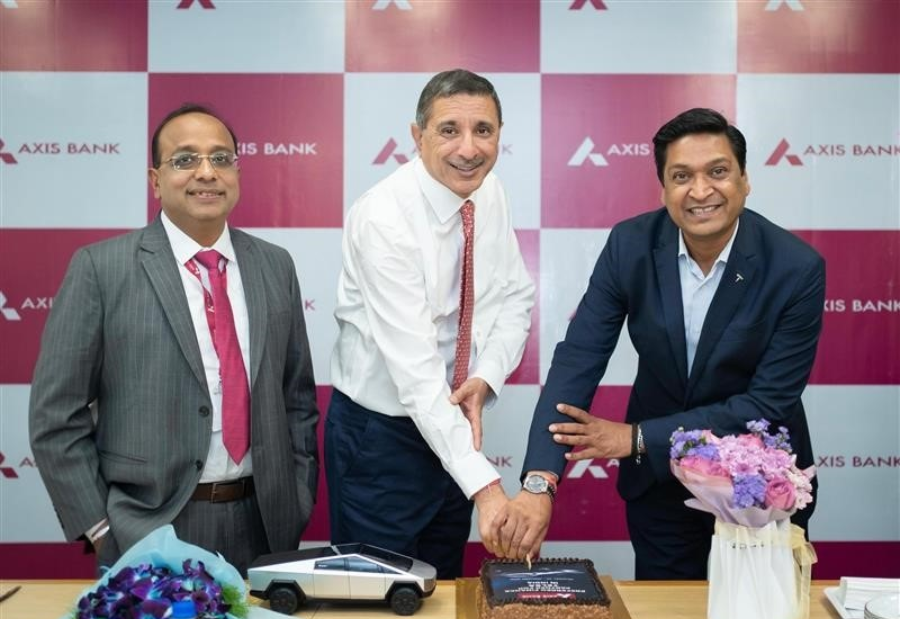
Buying a Tesla in India may soon become financially easier as Axis Bank partners with the electric vehicle maker to offer customised auto loans for its customers across the country.
Axis Bank has been designated as a preferred financing partner for Tesla in India, the two companies announced on Wednesday. The partnership aims to help customers access financing solutions tailored for Tesla electric vehicles and reduce the financial barriers associated with purchasing premium EVs.
The collaboration will be implemented nationwide, covering major metropolitan cities as well as smaller cities identified as emerging electric vehicle markets. Axis Bank will offer auto loans designed specifically for premium EV buyers. These loans will include customised repayment schedules aligned with individual cash flows, loan tenures of up to 10 years and a fully digital application and approval process to shorten the time between application and loan sanction.
The extended loan tenure stands out in India’s auto financing market, where standard car loans usually run between 5 years and 7 years. A longer repayment period can reduce monthly instalments, potentially making Tesla vehicles more accessible to a wider group of buyers who may otherwise be discouraged by the high upfront cost of imported electric cars.
Axis Bank Executive Director Munish Sharda said the partnership is intended to simplify the purchase process for Tesla buyers. “As electric mobility gains momentum in India, Axis Bank is proud to collaborate with Tesla to help accelerate this transition,” he said. “This makes it easier for customers to adopt sustainable mobility without compromising on convenience or flexibility.”
Tesla entered the Indian market in 2025 after several years of negotiations related to regulations and import duties. The company initially launched sales of its Model Y in select cities and has gradually expanded its retail and service network.
Despite strong consumer interest, high import duties on fully assembled vehicles have kept Tesla’s prices significantly higher than those of domestic EV manufacturers. As a result, financing options are expected to play an important role in influencing purchase decisions.
India’s electric vehicle sector has grown steadily in recent years, supported by government incentives, rising petrol and diesel prices and increasing investment in charging infrastructure. Policy initiatives such as the FAME scheme have focused on accelerating EV adoption across two-wheelers, three-wheelers and passenger vehicles. However, the premium passenger car segment, where Tesla operates, has witnessed relatively slower adoption compared to more affordable EV categories.
Private sector banks have been expanding EV-focused loan products as demand for electric vehicles rises. Preferential financing partnerships between banks and automakers are becoming more common as lenders look to build early relationships with EV brands in a rapidly growing market.
Axis Bank is one of India’s largest private sector banks by assets. As of September 2025, it operated 5,976 domestic branches and 13,177 ATMs and cash recycler machines. The bank provides services across retail, corporate, SME and agricultural segments, with group entities including Axis Mutual Fund, Axis Securities, Axis Finance and Freecharge.
Also read: Viksit Workforce for a Viksit Bharat
Do Follow: The Mainstream LinkedIn | The Mainstream Facebook | The Mainstream Youtube | The Mainstream Twitter
About us:
The Mainstream is a premier platform delivering the latest updates and informed perspectives across the technology business and cyber landscape. Built on research-driven, thought leadership and original intellectual property, The Mainstream also curates summits & conferences that convene decision makers to explore how technology reshapes industries and leadership. With a growing presence in India and globally across the Middle East, Africa, ASEAN, the USA, the UK and Australia, The Mainstream carries a vision to bring the latest happenings and insights to 8.2 billion people and to place technology at the centre of conversation for leaders navigating the future.