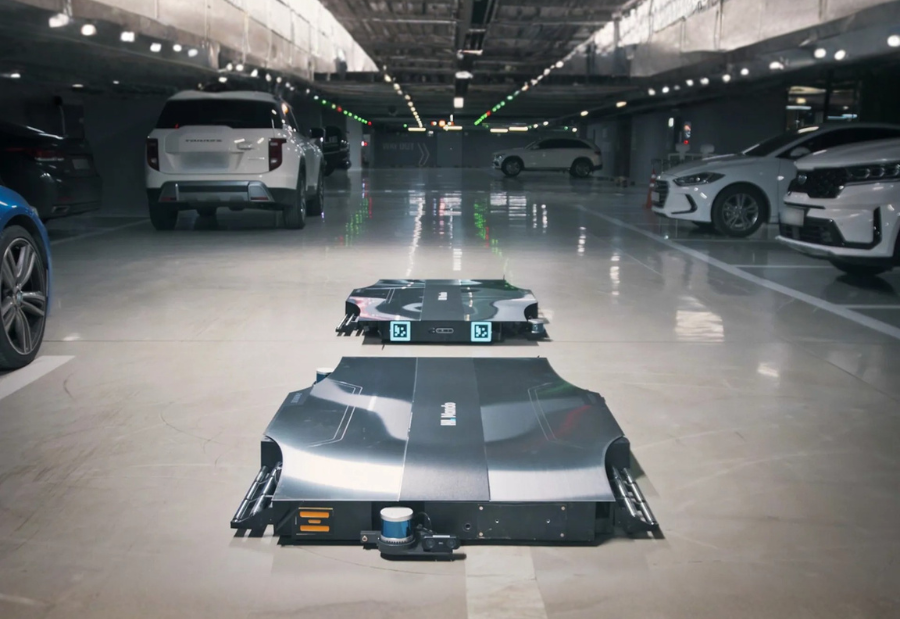
A quiet transformation is taking place inside parking garages, where robots are beginning to handle one of urban life’s most common frustrations. In South Korea, an automated parking system now operating in real facilities shows how robotics and reliable wireless connectivity are coming together to solve tight-space parking challenges.
HL Robotics has developed an automated parking solution called Parkie, designed to take drivers out of the parking process entirely. Instead of circling for a spot, drivers hand over their vehicles to robots that move and park them autonomously inside the garage.
The system is already live in working parking structures, with multiple robots operating at the same time. While the mechanical precision of the robots is important, the bigger challenge lies in maintaining constant communication inside concrete-heavy, multi-level garages where wireless signals are often unreliable.
In such environments, even a brief loss of connectivity can halt operations or raise safety concerns. To address this, Parkie relies on a robust wireless backbone that keeps every robot connected in real time as it moves.
Each robot depends on low-latency communication to track its exact position, coordinate with other robots, and respond instantly to commands. Parking garages are particularly difficult for wireless systems due to thick concrete walls, metal structures, moving vehicles, and changing layouts that can disrupt standard Wi-Fi networks.
To overcome these conditions, HL Robotics uses industrial-grade wireless technology designed for environments where dropped connections are not an option. The system supports near-zero latency and continuous communication, allowing robots to roam freely without losing signal. Seamless handoffs between access points ensure the connection stays active as robots move across different coverage areas.
Another key feature allows critical data to travel across multiple paths and frequencies at the same time. This reduces the risk of packet loss when many robots are operating together or when radio conditions shift suddenly.
Built-in monitoring tools track network performance in real time. If a disruption occurs, operators can quickly pinpoint the issue and respond without shutting down the entire system.
Parkie is designed to scale across different garage sizes, from small facilities to large commercial structures, with fleets ranging from a few robots to more than 10 operating simultaneously. The robots improve precision, reduce door damage, and allow vehicles to be parked closer together, increasing capacity without expanding physical space.
Beyond parking, the system highlights a broader shift in robotics. As robots move deeper into public infrastructure, wireless reliability is becoming just as critical as mechanical design. The same rugged networking approach is now being positioned for use in factories, logistics hubs, and outdoor industrial environments built to withstand heat, moisture, vibration, and physical obstacles.
Also read: Viksit Workforce for a Viksit Bharat
Do Follow: The Mainstream formerly known as CIO News LinkedIn Account | The Mainstream formerly known as CIO News Facebook | The Mainstream formerly known as CIO News Youtube | The Mainstream formerly known as CIO News Twitter
About us:
The Mainstream is a premier platform delivering the latest updates and informed perspectives across the technology business and cyber landscape. Built on research-driven, thought leadership and original intellectual property, The Mainstream also curates summits & conferences that convene decision makers to explore how technology reshapes industries and leadership. With a growing presence in India and globally across the Middle East, Africa, ASEAN, the USA, the UK and Australia, The Mainstream carries a vision to bring the latest happenings and insights to 8.2 billion people and to place technology at the centre of conversation for leaders navigating the future.