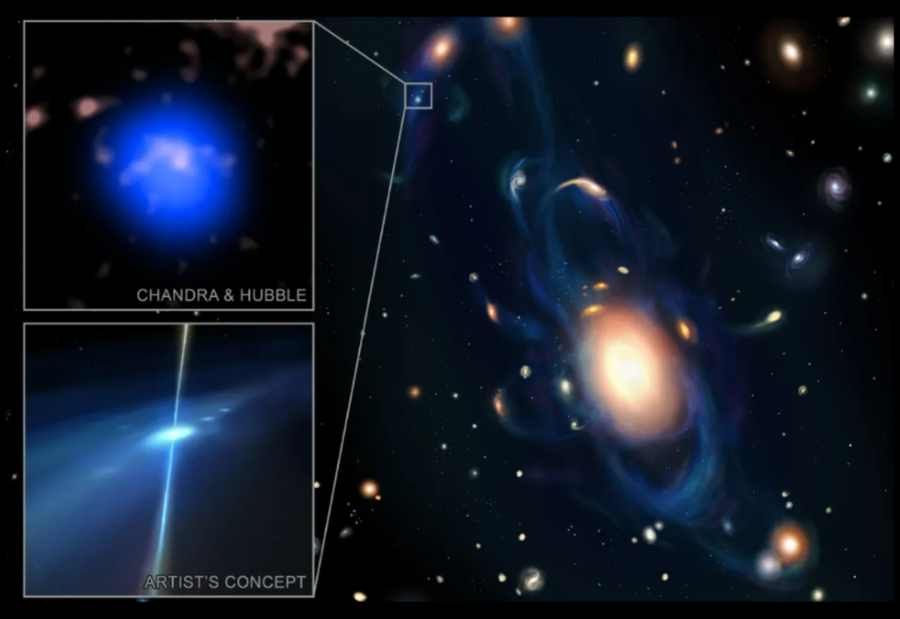
Astronomers have identified the origin of a powerful gamma-ray burst, revealing that it was triggered by a collision between two neutron stars in an unusual part of the universe. The discovery offers new insight into how some of the most energetic cosmic explosions occur and could help scientists better understand the formation of heavy elements such as gold and silver.
The gamma-ray burst, named GRB 230906A, was detected on September 23, 2023, by several space observatories including the Chandra X-ray Observatory, Fermi Gamma-ray Space Telescope, Neil Gehrels Swift Observatory, and the Hubble Space Telescope. Researchers traced the burst to a merger between two neutron stars inside a small galaxy located within a massive stream of gas measuring about 600,000 light-years in length. This gas structure is roughly 6 times wider than the entire Milky Way galaxy, making the discovery especially unusual.
Neutron stars form when massive stars exhaust their fuel and collapse after supernova explosions. Until now, collisions between these dense stellar remnants had mostly been observed in medium or large galaxies. The latest findings show that such powerful merger events can also occur in smaller galaxies. “Finding a neutron star collision where we did is game-changing,” said discovery team leader Simone Dichiara of Penn State University. “It may be the key to unlocking not one, but two important questions in astrophysics.” One mystery is that many gamma-ray bursts appear to occur far from dense galactic centers, where such collisions were expected to be more common.
Another scientific puzzle relates to the formation of heavy elements in the universe. Astronomers believe neutron star collisions create the extreme conditions needed to produce elements heavier than iron, including gold, silver, and platinum. However, these elements are sometimes found in stars located far from galactic centers and formed earlier than expected. Scientists described the event as a “collision within a collision,” as the merging galaxies likely triggered a wave of star formation that eventually led to the neutron star merger. “Chandra’s pinpoint X-ray localization made this study possible,” said team member Brendan O’Connor of Carnegie Mellon University. “Without it, we couldn’t have tied the burst to any specific source. And once Chandra told us exactly where to look, Hubble’s extraordinary sensitivity revealed the tiny, extremely faint galaxy at that position. We were only able to make this discovery after we put all the pieces together.”
Also read: Viksit Workforce for a Viksit Bharat
Do Follow: The Mainstream LinkedIn | The Mainstream Facebook | The Mainstream Youtube | The Mainstream Twitter
About us:
The Mainstream is a premier platform delivering the latest updates and informed perspectives across the technology business and cyber landscape. Built on research-driven, thought leadership and original intellectual property, The Mainstream also curates summits & conferences that convene decision makers to explore how technology reshapes industries and leadership. With a growing presence in India and globally across the Middle East, Africa, ASEAN, the USA, the UK and Australia, The Mainstream carries a vision to bring the latest happenings and insights to 8.2 billion people and to place technology at the centre of conversation for leaders navigating the future.