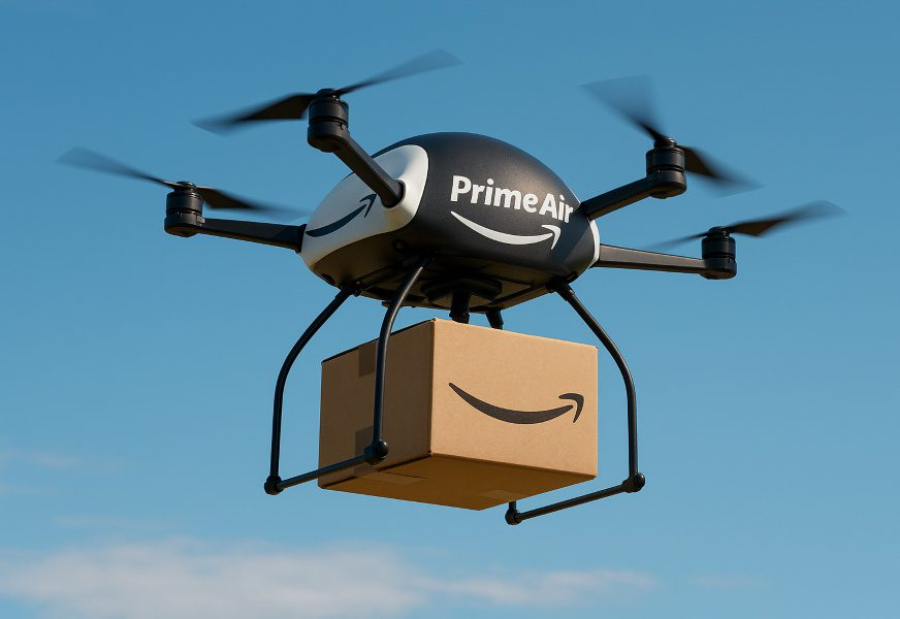
Amazon’s drone delivery division Prime Air has withdrawn from the Commercial Drone Alliance, citing disagreements over safety standards related to preventing collisions between drones and crewed aircraft.
In a letter sent on Wednesday and reviewed by Reuters, the Amazon unit said the alliance’s stance on key regulatory issues was “incompatible with Prime Air’s core safety tenets.” The disagreement centers on proposed regulations that would require drones to have systems capable of detecting and avoiding aircraft that are not broadcasting their location.
Prime Air said its own detect-and-avoid technology has already demonstrated its importance during operations. According to the company, in more than 70,000 drone flights, the system successfully carried out collision avoidance maneuvers in 2 potential mid-air incidents involving aircraft, situations that could have resulted in serious accidents.
The dispute relates to a proposal from the Federal Aviation Administration (FAA) introduced last year. The proposal suggests requiring drones to include systems that can detect and avoid aircraft that may not be transmitting their position, possibly due to equipment failure. The rule is part of broader efforts to allow drones to operate beyond the visual line of sight of operators, which could accelerate large-scale commercial drone delivery.
However, the Commercial Drone Alliance, a Washington-based industry group, has opposed the requirement. Instead, the alliance has suggested that aircraft flying below 500 feet (152 meters) should be required to broadcast their location using satellite-based systems that automatically share data such as position and speed.
The proposed FAA rules have not yet been finalized.
The alliance’s members include companies such as Skydio, Zipline, and Alphabet’s Wing Aviation. In response to Amazon’s decision, the group said it was disappointed to see Prime Air leave but noted that its members have conducted millions of safe drone operations. It argued that a performance-based framework, rather than mandatory technology requirements, is the best way to ensure safety while encouraging innovation.
Prime Air, however, emphasized that safe integration of drones into national airspace remains its top priority.
“This requires rigorous, capability-based standards – including requirements that mandate drone technologies capable of detecting non-cooperative crewed aircraft,” the company said.
The term non-cooperative crewed aircraft refers to planes or helicopters that do not transmit identification or location signals and may not communicate with air traffic control.
Prime Air noted that one of the near-collision incidents involved a helicopter that was not broadcasting Automatic Dependent Surveillance-Broadcast (ADS-B) signals, a safety system used to share aircraft location data. Without its detect-and-avoid system, the company said the situation “would have led to a catastrophic outcome.”
The company also warned that the risk of drone collisions with crewed aircraft is real. Concerns about airspace safety have grown following a January 2025 mid-air collision near Washington involving an American Airlines passenger jet and a U.S. Army helicopter, which resulted in 67 fatalities and led to safety recommendations from the National Transportation Safety Board.
Also read: Viksit Workforce for a Viksit Bharat
Do Follow: The Mainstream LinkedIn | The Mainstream Facebook | The Mainstream Youtube | The Mainstream Twitter
About us:
The Mainstream is a premier platform delivering the latest updates and informed perspectives across the technology business and cyber landscape. Built on research-driven, thought leadership and original intellectual property, The Mainstream also curates summits & conferences that convene decision makers to explore how technology reshapes industries and leadership. With a growing presence in India and globally across the Middle East, Africa, ASEAN, the USA, the UK and Australia, The Mainstream carries a vision to bring the latest happenings and insights to 8.2 billion people and to place technology at the centre of conversation for leaders navigating the future.