


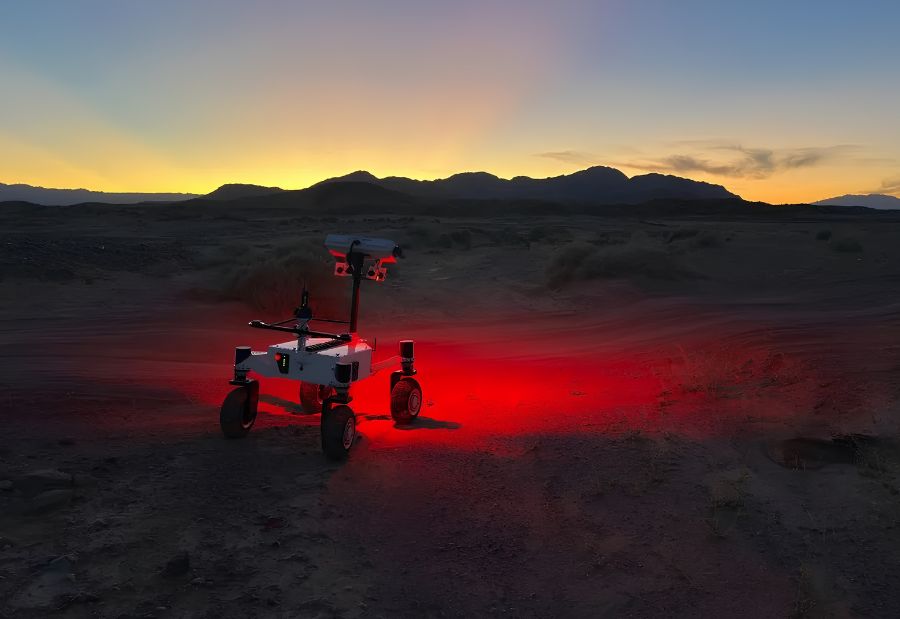
NASA is advancing the future of planetary exploration with a new rover prototype designed to travel across some of the toughest landscapes on the Moon and Mars. The Exploration Rover for Navigating Extreme Sloped Terrain (ERNEST), developed at NASA’s Jet Propulsion Laboratory (JPL), recently completed a 16-mile (26 km) autonomous journey across the Southern California desert, marking a major step toward smarter robotic exploration.
The 37-hour drive was completed over 7 days with minimal intervention from engineers. NASA aims to use ERNEST’s technology in future lunar and Martian missions, allowing rovers to cover greater distances, move faster, and independently assess difficult terrain. “This testing is helping us refine the mobility hardware and autonomy software to navigate extreme distances across a wide range of terrain and lighting conditions anticipated on the moon,” said Issa Nesnas, a JPL principal technologist.
Development of ERNEST began in 2022 through JPL’s internal research and development program. It is now part of NASA’s Science Mission Directorate’s Exploration Science Strategy and Integration Office and the Mars Exploration Program.
ERNEST features a new wheel design, an active suspension system, and adaptive artificial intelligence that helps it detect, avoid, or overcome obstacles. Its AI capabilities were developed through reinforcement learning in a virtual environment, where thousands of hours of experience were generated within days using multiple simulations. Before its desert trial, the rover successfully completed testing at JPL’s Mars Yard obstacle course.
Unlike traditional 6-wheeled rovers such as Perseverance and Opportunity that use a rocker-bogie suspension system, the 4-wheeled ERNEST uses 2 front chassis joints that adjust its movement through “squirming, wheel-walking, and obstacle-climbing.” Each wheel can also steer independently, allowing movement forward, backward, and sideways. “While the rocker-bogie system has been very successful over the past 30 years, there’s been a lot of research in that time on mobility and understanding terrain interaction,” said Hari Nayar, lead principal technologist for the ERNEST team.
During testing in March, ERNEST also operated in nighttime and low-light conditions. The rover measures 4 ft (1.2 m) long and reached speeds of up to 0.6 mph (1 kph), faster than current Moon and Mars rovers. Engineers expect ERNEST to shape the design of larger and more capable future exploration vehicles.
Also read: Viksit Workforce for a Viksit Bharat
Do Follow: The Mainstream LinkedIn | The Mainstream Facebook | The Mainstream Youtube | The Mainstream Twitter
About us:
The Mainstream is a premier platform delivering the latest updates and informed perspectives across the technology business and cyber landscape. Built on research-driven, thought leadership and original intellectual property, The Mainstream also curates summits & conferences that convene decision makers to explore how technology reshapes industries and leadership. With a growing presence in India and globally across the Middle East, Africa, ASEAN, the USA, the UK and Australia, The Mainstream carries a vision to bring the latest happenings and insights to 8.2 billion people and to place technology at the centre of conversation for leaders navigating the future.