


Astronomers have identified a rare and highly unusual planetary system that is behaving unlike anything observed before, offering new insights into how planets form and evolve.
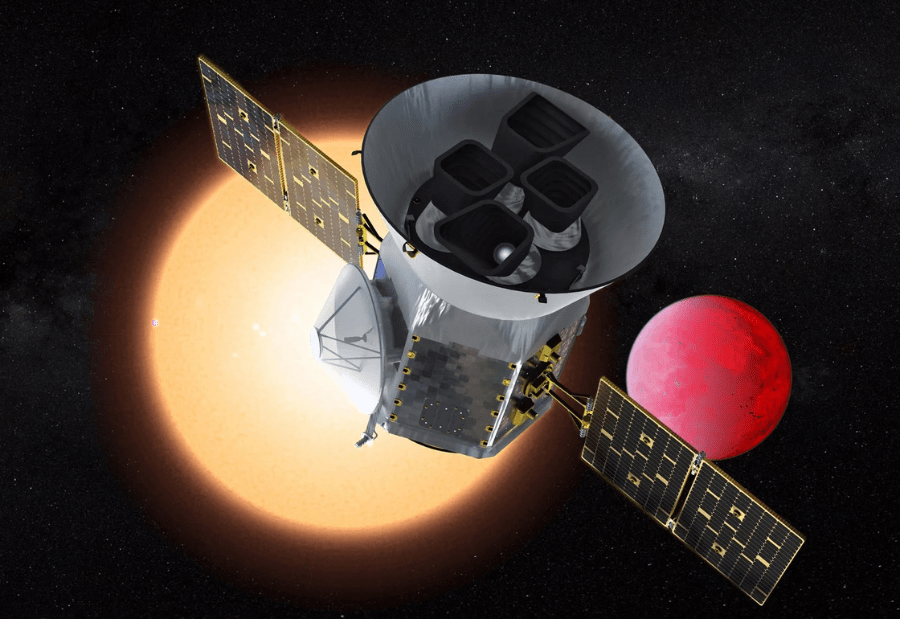
Using Transiting Exoplanet Survey Satellite (TESS) and the Antarctic Search for Transiting ExoPlanets (ASTEP), scientists discovered a unique system around the star TOI-201, located about 370 light-years from Earth. What sets this system apart is that the planets’ orbits are shifting so rapidly that astronomers can observe these changes in real time.
TOI-201 is about 1.3 times the mass and diameter of the Sun. Orbiting it are 3 very different planets. These include a rocky super-Earth with 6 times Earth’s mass and an orbital period of just 5.8 days. Another planet, TOI-201b, is a gas giant with half the mass of Jupiter and completes an orbit every 53 days. The third is a massive gas giant with 16 times Jupiter’s mass, taking 2,883 days, or about 7.9 years, to orbit the star.
“Most planetary systems appear as ‘peas in a pod,’ meaning the planets have a similar range of parameters and share a similar orbital plane,” said Amaury Triaud. “This is not the case in the TOI-201 system, which contains three orbiting objects very distinct from one another, and which interact gravitationally.”
The findings were published on April 15 in the journal Science.
While orbital changes in planetary systems are not uncommon, they usually occur over millions or billions of years. In contrast, TOI-201 shows rapid changes due to the highly elliptical and tilted orbit of its outer planet. This planet exerts strong gravitational forces, altering the orientation of inner planets and shifting their transit timings.
“In the solar system, almost all planets are coplanar, but here, this is not the case and each planet is different,” said Tristan Guillot. “This points to some active orbital reorganisation within the system, providing us a glimpse of what happens shortly after planet formation.”
The ASTEP observatory, located at Concordia Station, played a key role by leveraging long polar nights for observation.
Research lead Ismael Mireles said, “The goal was to characterize the TOI-201 planetary system to understand not just what planets are there, but how they interact with each other dynamically.”
TESS first detected a rare transit from the outer planet, while telescopes worldwide observed its gravitational effects on the system. Scientists noticed delays in TOI-201b’s transit timing, sometimes by around 30 minutes, indicating strong gravitational interactions.
“Usually, planets are like metronomes… however, we were following TOI-201b, and suddenly the planet started transiting about half an hour late,” Triaud said.
The discovery highlights the importance of global collaboration and unique observation points like Antarctica in advancing exoplanet research.
Also read: Viksit Workforce for a Viksit Bharat
Do Follow: The Mainstream LinkedIn | The Mainstream Facebook | The Mainstream Youtube | The Mainstream Twitter
About us:
The Mainstream is a premier platform delivering the latest updates and informed perspectives across the technology business and cyber landscape. Built on research-driven, thought leadership and original intellectual property, The Mainstream also curates summits & conferences that convene decision makers to explore how technology reshapes industries and leadership. With a growing presence in India and globally across the Middle East, Africa, ASEAN, the USA, the UK and Australia, The Mainstream carries a vision to bring the latest happenings and insights to 8.2 billion people and to place technology at the centre of conversation for leaders navigating the future.