


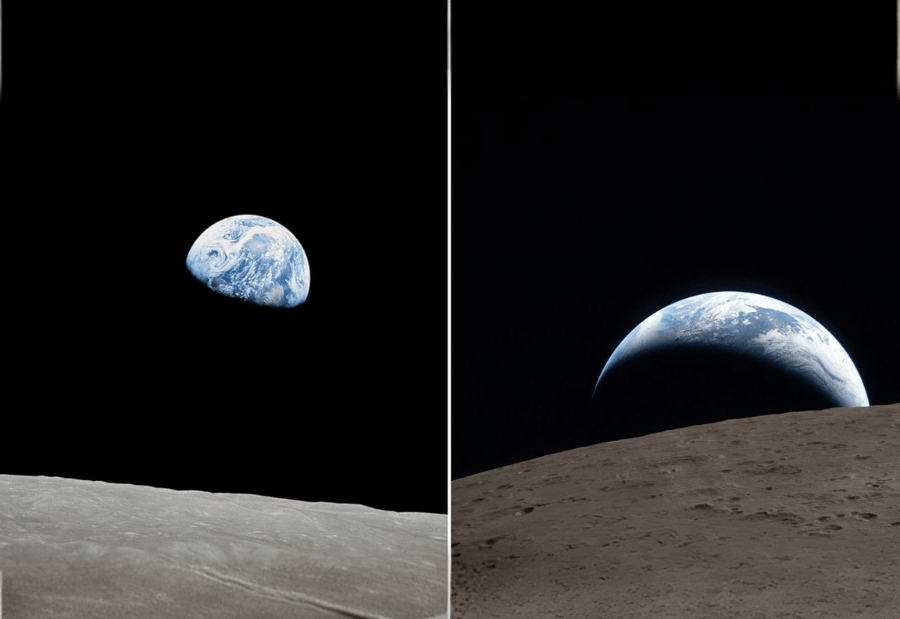
When astronauts aboard Apollo 8 captured the iconic “Earthrise” image in 1968, it transformed how humanity viewed its place in the universe. Now, nearly 58 years later, astronauts from Artemis II have recreated a similar moment with a new image known as “Earthset,” offering a powerful comparison of how Earth has changed.
The original Earthrise photo, taken by Bill Anders, showed a vibrant blue planet rising above the Moon’s barren surface. It became one of the most influential images ever captured, inspiring global environmental awareness and contributing to movements like Earth Day.
The newly captured Earthset image, taken during a lunar flyby in April 2026 from NASA’s Orion spacecraft, shows Earth dipping below the Moon’s horizon. While visually similar, the two images represent very different planetary realities.
Experts say that in the decades between these images, Earth has undergone significant transformation. According to climate scientists, atmospheric carbon dioxide levels have increased by about 33%, while global temperatures have risen by at least 1°C.
These changes have reshaped the planet’s surface. Expanding cities, deforestation, and agricultural growth have altered land patterns visible from space. Water systems have also been affected, with the Aral Sea shrinking to less than 10% of its size from the 1960s.
The most visible changes are in Earth’s cryosphere. Regions like Antarctica have experienced rapid warming, with nearly 28,000 km of ice shelf collapsing over this period. Seasonal sea ice has declined across both hemispheres, while snow cover in parts of North America, Eurasia, and Asia now melts earlier and forms later.
Scientists attribute around 90–95% of these changes to human activity, highlighting the growing impact of industrialisation and environmental pressure.
Despite modern satellites continuously capturing Earth in high detail, images like Earthrise and Earthset hold unique value. Human-captured photographs bring emotional depth and perspective, reminding people of Earth’s fragility in the vastness of space.
What began as an accidental snapshot in 1968 has evolved into a deliberate reflection of planetary change. Together, these two images tell a powerful story—not just of exploration, but of how much Earth has changed in a short span of time.
Also read: Viksit Workforce for a Viksit Bharat
Do Follow: The Mainstream LinkedIn | The Mainstream Facebook | The Mainstream Youtube | The Mainstream Twitter
About us:
The Mainstream is a premier platform delivering the latest updates and informed perspectives across the technology business and cyber landscape. Built on research-driven, thought leadership and original intellectual property, The Mainstream also curates summits & conferences that convene decision makers to explore how technology reshapes industries and leadership. With a growing presence in India and globally across the Middle East, Africa, ASEAN, the USA, the UK and Australia, The Mainstream carries a vision to bring the latest happenings and insights to 8.2 billion people and to place technology at the centre of conversation for leaders navigating the future.