


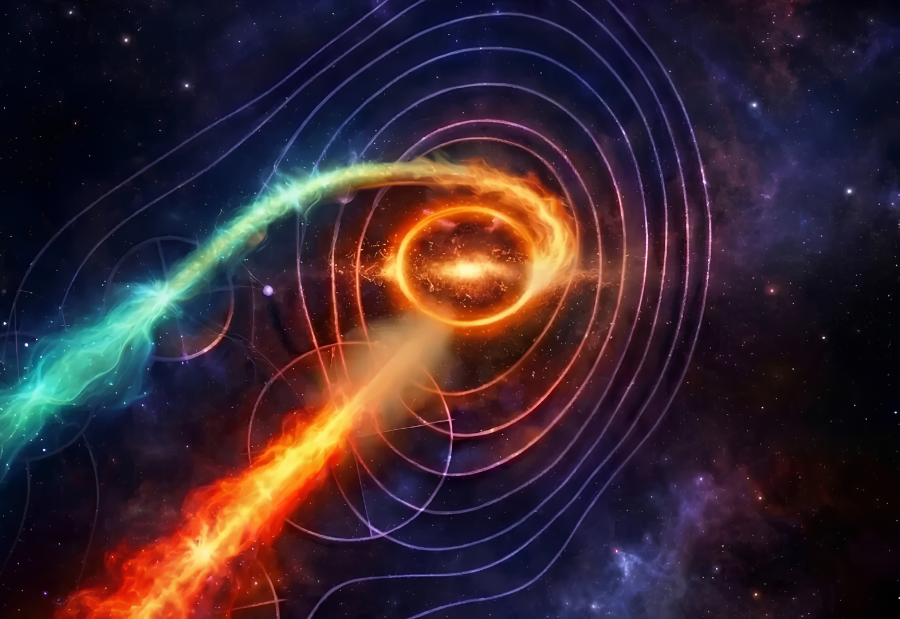
In a breakthrough discovery, astronomers have found direct evidence of 2 supermassive black holes orbiting each other at close range in the galaxy Markarian 501, offering rare insight into a key process of galaxy evolution.
The research, led by Silke Britzen from the Max Planck Institute for Radio Astronomy, suggests this could be the first observed pair on the verge of merging. The findings have been published in the Monthly Notices of the Royal Astronomical Society.
Supermassive black holes are believed to exist at the center of most large galaxies, with masses millions or billions of times that of the Sun. Scientists have long theorised that these massive objects grow by merging with other black holes, especially during galaxy collisions. However, direct evidence of such close pairs has remained elusive—until now.
The discovery was made by studying the galaxy Markarian 501 in the constellation Hercules. Using high-resolution radio observations collected over 23 years, researchers identified not just 1 but 2 powerful jets of particles, indicating the presence of 2 black holes.
The first jet, pointing toward Earth, appeared brighter and was already known. The second jet, oriented differently, was harder to detect but showed clear movement, orbiting the larger black hole in a counterclockwise pattern.
“We searched for it for so long, and then it came as a complete surprise that we could not only see a second jet, but even track its movement,” Britzen said.
At one point in June 2022, the system created a ring-shaped effect known as an Einstein ring, likely caused by gravitational lensing when the system aligned perfectly with Earth.
Analysis suggests the 2 black holes orbit each other every 121 days and are separated by a distance roughly 250 to 540 times that between Earth and the Sun. Despite this distance, it is extremely close for objects of such massive scale. Scientists estimate they could merge within 100 years.
While current telescopes cannot directly image both black holes separately, researchers expect to detect their presence through low-frequency gravitational waves using pulsar timing arrays.
This discovery also supports earlier findings of a gravitational wave background detected in 2023, believed to be caused by merging supermassive black hole pairs.
“If gravitational waves are detected, we may even see their frequency steadily rise as the two giants spiral toward collision,” said co-author Héctor Olivares.
The finding marks a major step in understanding how galaxies evolve and how supermassive black holes grow over time.
Also read: Viksit Workforce for a Viksit Bharat
Do Follow: The Mainstream LinkedIn | The Mainstream Facebook | The Mainstream Youtube | The Mainstream Twitter
About us:
The Mainstream is a premier platform delivering the latest updates and informed perspectives across the technology business and cyber landscape. Built on research-driven, thought leadership and original intellectual property, The Mainstream also curates summits & conferences that convene decision makers to explore how technology reshapes industries and leadership. With a growing presence in India and globally across the Middle East, Africa, ASEAN, the USA, the UK and Australia, The Mainstream carries a vision to bring the latest happenings and insights to 8.2 billion people and to place technology at the centre of conversation for leaders navigating the future.