


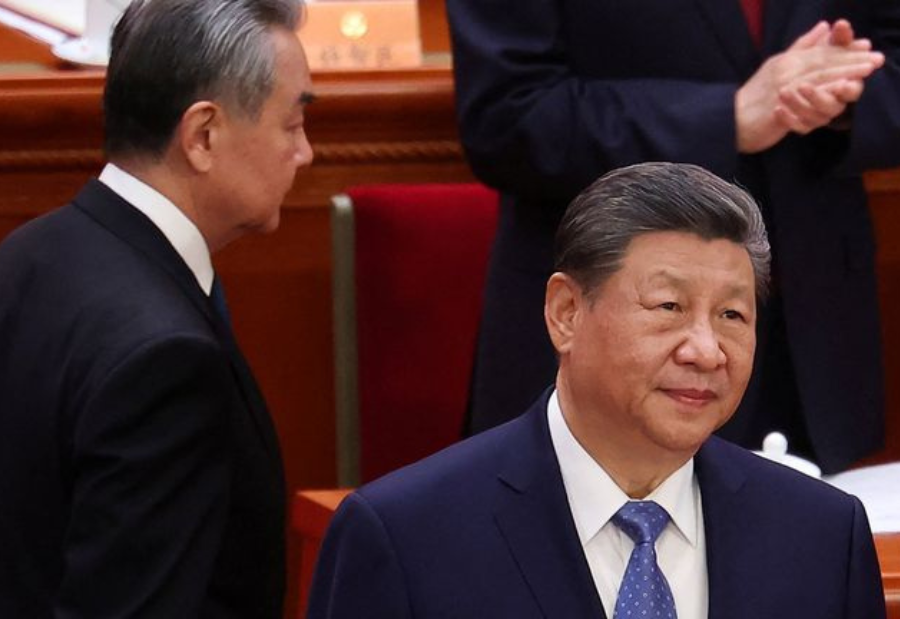
China’s latest economic strategy shows a dual focus on strengthening its domestic economy while accelerating technological advancement to compete globally.
Two key policy blueprints unveiled during the annual meeting of China’s legislature reveal the country’s priorities. In the government’s economic plan for 2026, the top task is “building a robust domestic market”, followed by accelerating technological progress. However, the longer-term 5-year plan places stronger emphasis on achieving breakthroughs in advanced technology.
The difference highlights China’s balancing act. The government aims to transform the country from a low-cost manufacturing hub into a technology-driven economy. At the same time, it is trying to address a period of economic slowdown that has weakened consumer and business confidence.
China’s economic decisions have global impact because the country is one of the world’s largest exporters. The plans were presented at the opening of the National People’s Congress and are expected to be formally approved at the end of the 8-day session on Thursday.
Analysts believe technological strength remains a key objective for Chinese leader Xi Jinping. His long-term vision is to position China as a global power capable of competing with the United States on issues ranging from trade to Taiwan tensions.
During a meeting with a provincial delegation, Xi called for new breakthroughs, original innovation and “seizing the strategic high ground of science and technology”, according to a state media report.
China’s rapid growth has already made it the world’s 2nd-largest economy. To continue advancing, the government is pushing industries toward higher-value sectors. For example, strong state support for electric vehicles has helped China become an emerging force in the global automobile market while supporting climate goals.
The 5-year plan states that China will “target the frontiers of science and technology”, accelerating development in artificial intelligence, quantum technology, biotechnology and new energy.
Technology competition with the United States has also intensified. The US has restricted Chinese companies’ access to advanced technologies, including semiconductors used in artificial intelligence, citing concerns that they could be used in military systems.
In response, China has increased investments to develop its own technologies and reduce reliance on foreign suppliers. The plan states that China must “fight the battle for key core technologies”.
Key targets include progress in semiconductors, batteries, robotics, biomedicine and 6G mobile networks. The plan also aims to expand production of China’s domestically developed passenger jet C919 and develop its own commercial aircraft engine after Western engine supplies were temporarily cut off last year during trade tensions.
Rare earth elements, where China dominates global supply, were also highlighted as a strategic advantage.
Meanwhile, rising exports have supported China’s economy even as domestic growth slows. However, tariffs introduced by US President Donald Trump have exposed risks of relying heavily on foreign markets. China managed to redirect exports to other regions, but its record trade surplus of nearly USD 1.2 trillion has raised concerns in other countries about job losses and economic pressure.
This has pushed China to boost consumer spending at home. The annual plan stated, “Facing a complex and challenging international environment, we must remain committed to the strategy of expanding domestic demand.”
Despite the strong messaging, analysts say the policies appear aimed more at stabilising the economy than driving rapid expansion. China has set a growth target of 4.5 per cent to 5 per cent for 2026, slightly below last year’s 5-per-cent growth.
Economists note that the government is likely to provide large subsidies for advanced manufacturing. Similar support previously given to wind and solar industries created manufacturing oversupply, which was exported globally at very low prices and intensified competition for overseas producers.
Experts warn that this strategy could widen the imbalance between China’s vast manufacturing capacity and weaker domestic demand, potentially leading to even higher export levels in the future.
Also read: Viksit Workforce for a Viksit Bharat
Do Follow: The Mainstream LinkedIn | The Mainstream Facebook | The Mainstream Youtube | The Mainstream Twitter
About us:
The Mainstream is a premier platform delivering the latest updates and informed perspectives across the technology business and cyber landscape. Built on research-driven, thought leadership and original intellectual property, The Mainstream also curates summits & conferences that convene decision makers to explore how technology reshapes industries and leadership. With a growing presence in India and globally across the Middle East, Africa, ASEAN, the USA, the UK and Australia, The Mainstream carries a vision to bring the latest happenings and insights to 8.2 billion people and to place technology at the centre of conversation for leaders navigating the future.