


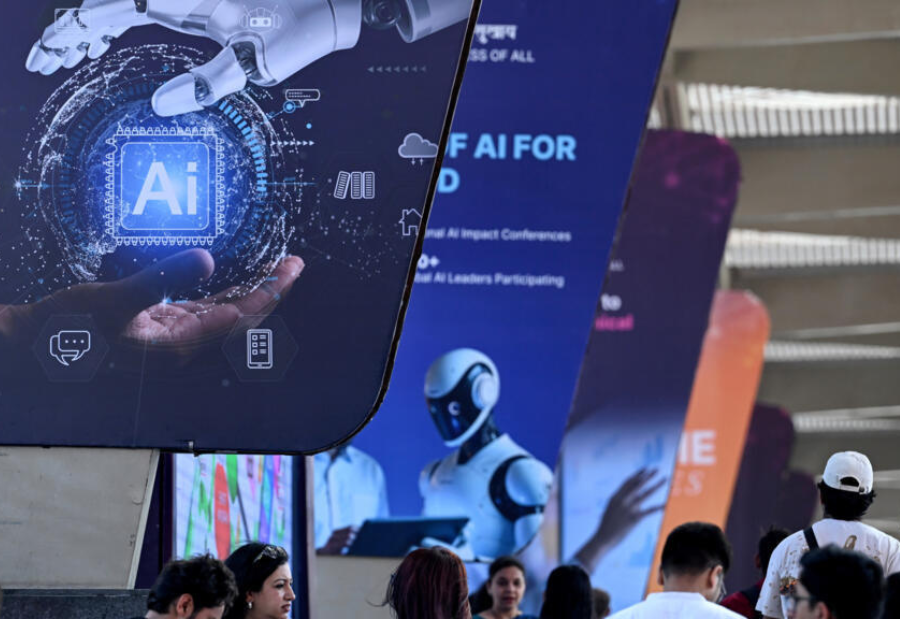
India’s ambition to become a global artificial intelligence powerhouse gained momentum as leading technology companies announced new investments, partnerships, and infrastructure projects during a major AI conference in New Delhi.
At the AI Impact Summit, US technology giant Google revealed plans to build new subsea cables connecting India with Singapore, South Africa, and Australia to strengthen digital connectivity as demand for AI computing grows. The announcement forms part of the company’s $15 billion investment unveiled in October to develop its largest AI data centre hub outside the US in Visakhapatnam.
“India’s going to have an extraordinary trajectory with AI and we want to be a partner,” said Sundar Pichai while speaking to reporters.
Chipmaker Nvidia also announced collaborations with 3 Indian cloud computing providers to supply advanced processors for AI data centres capable of training and running AI systems. The company is additionally partnering with Mumbai-based L&T to build what it described as “India’s largest gigawatt-scale AI factory”.
“We are laying the foundation for world-class AI infrastructure that will power India’s growth,” said Nvidia CEO Jensen Huang.
Nvidia is also working with AI infrastructure firm Yotta, which announced a $2 billion agreement to deploy 20,000 high-end AI processors.
The summit, now in its 4th year, has brought together dozens of global leaders and ministers to discuss AI opportunities and risks, including job disruption and misinformation. India recently moved to 3rd place in a global AI competitiveness ranking by Stanford University researchers, overtaking South Korea and Japan, though experts say it still trails the US and China.
India’s IT minister Ashwini Vaishnaw said the country expects more than $200 billion in AI-related investments over the next 2 years, including nearly $90 billion already committed.
Other announcements included Microsoft pledging $50 billion this decade to expand AI adoption in developing nations, while Anthropic and Infosys plan to build AI agents for the telecom sector.
Leaders including Prime Minister Narendra Modi, French President Emmanuel Macron, and Brazil’s Luiz Inacio Lula da Silva are expected to issue a joint statement addressing AI governance concerns.
According to Nick Patience of Futurum, nonbinding agreements may still “set the tone for what acceptable AI governance looks like”. He added that “the largest AI companies deploy capabilities at a pace that makes 18-month legislative cycles look glacial,” raising questions about whether governments can move fast enough to establish safeguards.
Also read: Viksit Workforce for a Viksit Bharat
Do Follow: The Mainstream LinkedIn | The Mainstream Facebook | The Mainstream Youtube | The Mainstream Twitter
About us:
The Mainstream is a premier platform delivering the latest updates and informed perspectives across the technology business and cyber landscape. Built on research-driven, thought leadership and original intellectual property, The Mainstream also curates summits & conferences that convene decision makers to explore how technology reshapes industries and leadership. With a growing presence in India and globally across the Middle East, Africa, ASEAN, the USA, the UK and Australia, The Mainstream carries a vision to bring the latest happenings and insights to 8.2 billion people and to place technology at the centre of conversation for leaders navigating the future.