


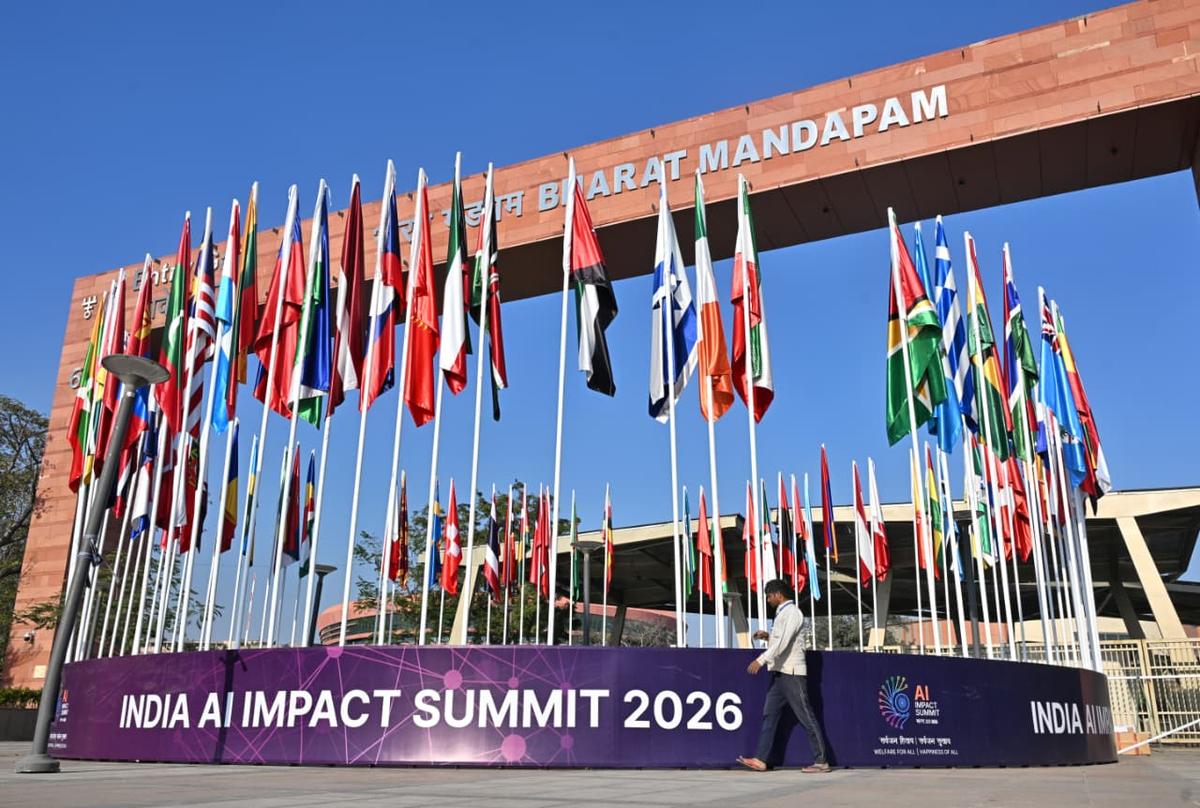
New Delhi: Day 2 of the AI Impact Summit 2026 at Bharat Mandapam sharpened the conversation around a central question- how can India scale artificial intelligence without leaving jobs, ethics and equity behind?
With participation from over 100 countries, the summit moved beyond vision statements to policy direction, sectoral launches and sharper global comparisons. Here’s a round-up of key developments till 3 PM.
Jobs, Skills and the “Human Abundance” Thesis
Chief Economic Advisor V Anantha Nageswaran made a case for aligning AI adoption with mass employability. He argued that India’s AI strategy must go hand-in-hand with improvements in education, vocational skills, and labour-intensive services, while also reducing regulatory bottlenecks.
The CEA called for deeper collaboration between private industry, academia and policymakers to ensure that AI amplifies what he described as India’s potential for “human abundance” a model where technology augments rather than sidelines the workforce.
Meanwhile, Union Minister for Railways, Communications and Electronics & IT Ashwini Vaishnaw announced AI Mission 2.0, positioning it as the next phase focused on research and development, domestic innovation and wider accessibility of AI across sectors such as healthcare and education.
From industry, Nasscom AI head Ankit Bose maintained that AI would transform jobs rather than eliminate them outright, especially in services and digital roles.
Union Minister of State for Health Anupriya Patel underlined the need for AI literacy among doctors, stressing that AI should support medical professionals not replace them and help close access gaps in healthcare delivery.
Healthcare-Focused Launches: SAHI and BODH
Healthcare emerged as one of the most concrete focus areas of the day.
Union Health Minister JP Nadda launched SAHI, a framework aimed at ethical AI deployment in healthcare systems. Alongside it, the Ministry unveiled BODH, a privacy-preserving platform designed to evaluate health AI models using real-world data sets without compromising patient confidentiality.
Knowledge compendiums were also released, covering AI use cases across health, energy, education, agriculture, gender empowerment and disability inclusion, an attempt to document best practices and guide implementation at scale.
A dedicated seminar on Applied AI was held at Bharat Mandapam, while Sushma Swaraj Bhawan hosted the AI by HER: Global Impact Challenge, spotlighting women leaders building AI-led solutions.
Gender Gap in AI Under Spotlight
Gender representation in AI took centre stage in one of the global sessions.
UN Women highlighted that women account for only about 30% of AI professionals globally and an even smaller 16% in AI research roles. The concern, speakers noted, is that underrepresentation can lead to embedded biases in AI tools used in health diagnostics, financial scoring and climate modelling.
Regional Director Christine Arab called for stronger female participation during the launch of the AI Casebook on Gender and Agriculture, framing inclusion not as a diversity checkbox but as a structural necessity for better-designed systems.
India’s Talent Pitch and Public-Interest AI
India’s broader positioning as an AI powerhouse was reinforced by Amitabh Kant, who pointed to the country’s demographic dividend, startup ecosystem and expanding digital infrastructure. He emphasised that talent, computing power and skilling initiatives must converge to build a more equitable society.
Prime Minister Narendra Modi, in his remarks, reiterated that AI must serve public interest, guided by intelligence and rationality rather than unchecked automation.
Expo Floor: From Industrial Robots to AI Cricket Coaches
Parallel to policy discussions, the AI Impact Expo continued to draw heavy footfall. The exhibition features over 600 startups and 13 country pavilions.
Tata Consultancy Services showcased a quadruped robot designed for industrial applications such as navigating rubble, inspecting hazardous environments and diagnosing structural failures. Meanwhile, Google drew crowds with an AI-powered cricket coach capable of analysing batting shots in real time
The Bottom Line (Till 3 PM):
Day 2 has shifted the summit narrative from broad AI ambition to structured implementation with employability, healthcare governance and gender equity emerging as recurring themes. The policy tone suggests India is attempting a calibrated approach: accelerating AI capability while embedding safeguards and skill-building into the rollout.
More announcements and sectoral sessions are expected later in the day.
Also read: Viksit Workforce for a Viksit Bharat
Do Follow: The Mainstream LinkedIn | The Mainstream Facebook | The Mainstream Youtube | The Mainstream Twitter
About us:
The Mainstream is a premier platform delivering the latest updates and informed perspectives across the technology business and cyber landscape. Built on research-driven, thought leadership and original intellectual property, The Mainstream also curates summits & conferences that convene decision makers to explore how technology reshapes industries and leadership. With a growing presence in India and globally across the Middle East, Africa, ASEAN, the USA, the UK and Australia, The Mainstream carries a vision to bring the latest happenings and insights to 8.2 billion people and to place technology at the centre of conversation for leaders navigating the future.