


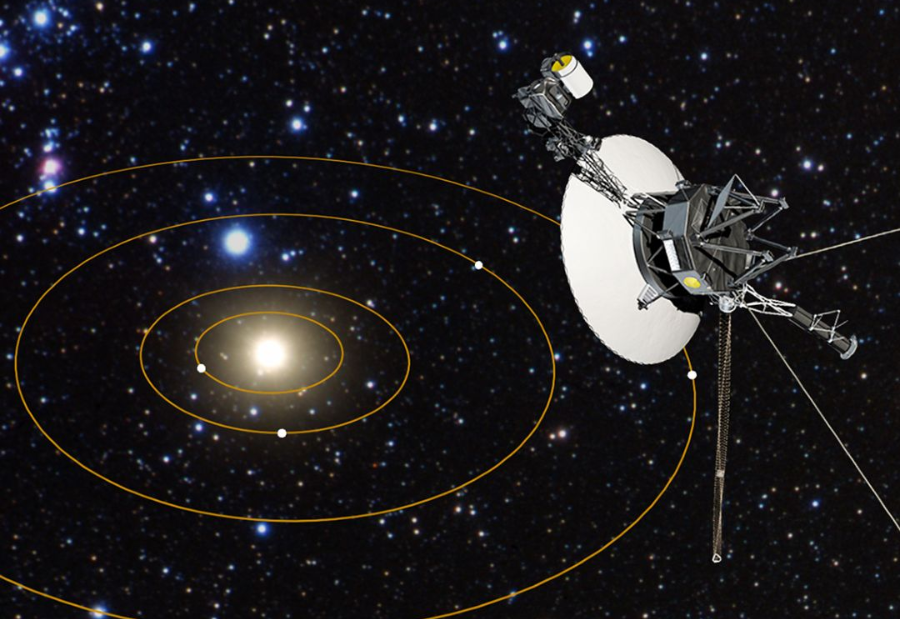
Far beyond the reach of our Sun’s influence, Voyager 1 continues to send signals back to Earth. Launched in 1977 for a planned 4-year mission to Saturn, the 825 kg spacecraft has now been travelling for 48 years and remains active in interstellar space.
As of February 13, 2026, Voyager 1 is about 25.43 billion km from Earth. A radio signal moving at the speed of light now takes 23 hours and 33 minutes to travel one way. By mid-November 2026, it is expected to cross the one-light-day mark. At that point, any signal will take 24 hours to reach Earth and another 24 hours to return.
How is Voyager 1 still working?
Voyager 1 does not use solar panels. It runs on 3 radioisotope thermoelectric generators powered by decaying plutonium 238. At launch, they produced 470 watts. The output drops by about 4 watts every year.
Today, the spacecraft operates on around 200 watts. This is barely enough to power a few household light bulbs. To conserve energy, engineers have shut down non-essential systems. Earlier this year, the cosmic ray sensor was turned off to save power for heaters. Without heat, fuel lines could freeze, making it impossible for the spacecraft to orient itself.
Every watt now supports critical systems, especially the antenna that must remain pointed at Earth.
How do we detect such a weak signal?
By the time Voyager 1’s signal reaches Earth, it is less than one trillionth of a watt. A home Wi-Fi signal is about 100 billion times stronger.
Communication depends on Nasa’s Deep Space Network. This global system uses massive 70-metre antennas to capture faint signals. Data arrives at just 160 bits per second, much slower than a 1990s dial-up modem. Downloading a modern smartphone photo would take weeks.
Even a simple command from Earth takes 23 hours to arrive. Engineers must wait nearly 2 days to confirm whether a fix worked.
What happens if Voyager 1 breaks down?
The onboard computers have only 68 kilobytes of memory. Engineers rely on 1970s paper blueprints to solve technical issues.
Between May 2025 and early 2026, Deep Space Station 43 in Canberra, the only antenna capable of sending commands to Voyager 1, was offline for upgrades. During this time, any major fault could have ended the mission.
Recently, a German observatory detected Voyager 1’s carrier signal on a live stream, confirming it is still transmitting.
Will the mission ever end?
The spacecraft is running on borrowed time. By 2030, it may not have enough power to operate even 1 instrument.
Even when communication stops, Voyager 1 will continue drifting through space. It carries the Golden Record, a gold-plated copper disk with sounds and images of Earth. Long after its signal fades, it will remain a silent ambassador of humanity in the Milky Way.
Also read: Viksit Workforce for a Viksit Bharat
Do Follow: The Mainstream formerly known as CIO News LinkedIn Account | The Mainstream formerly known as CIO News Facebook | The Mainstream formerly known as CIO News Youtube | The Mainstream formerly known as CIO News Twitter
About us:
The Mainstream is a premier platform delivering the latest updates and informed perspectives across the technology business and cyber landscape. Built on research-driven, thought leadership and original intellectual property, The Mainstream also curates summits & conferences that convene decision makers to explore how technology reshapes industries and leadership. With a growing presence in India and globally across the Middle East, Africa, ASEAN, the USA, the UK and Australia, The Mainstream carries a vision to bring the latest happenings and insights to 8.2 billion people and to place technology at the centre of conversation for leaders navigating the future