


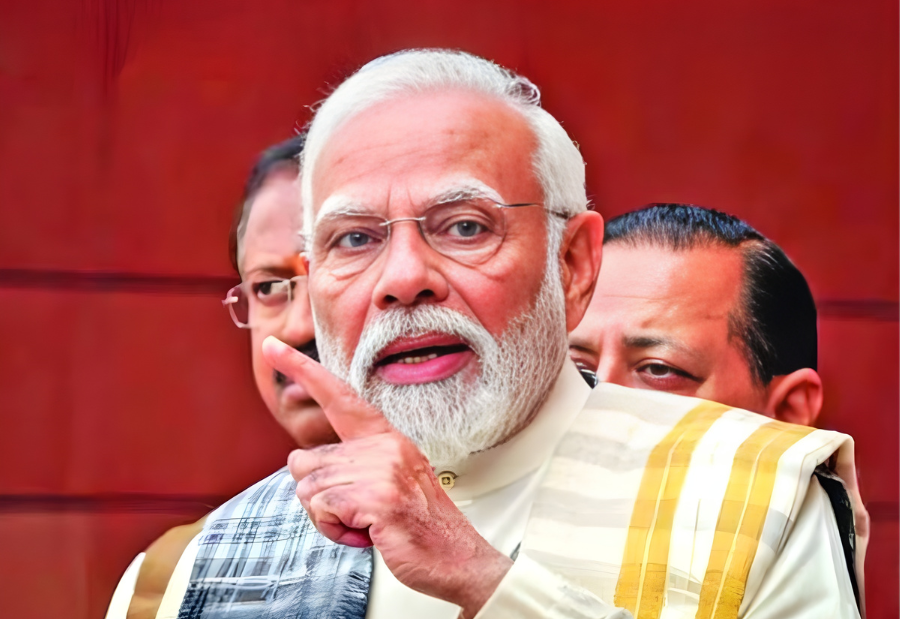
A significant chapter in India’s administrative history will close on Friday, February 13, 2026, as Prime Minister Narendra Modi inaugurates the new Prime Minister’s Office at ‘Seva Teerth’ and presides over the final Union Cabinet meeting at South Block.
With this move, the iconic North and South Blocks will be vacated, marking the end of an era. The buildings originally housed the British administration and were taken over by independent India in 1947. They were designed by Herbert Baker, a contemporary of Edwin Lutyens, the architect behind Lutyens’ Delhi.
The South Block currently accommodates the Prime Minister’s Office and the Ministries of External Affairs and Defence. The North Block houses the Ministries of Home Affairs and Finance.
The Prime Minister’s Office will now function from the newly constructed ‘Seva Teerth’ complex. The new facility will also house the National Security Council Secretariat and the Cabinet Secretariat, which were earlier located at different places.
Alongside this transition, Kartavya Bhavan 1 and 2 will accommodate several key Ministries. These include Finance, Defence, Health and Family Welfare, Education, Corporate Affairs, Culture, Law and Justice, Information and Broadcasting, Agriculture and Farmers Welfare, Chemicals and Fertilizers, and Tribal Affairs.
Both complexes are designed as digitally integrated office spaces with structured public interface zones and centralised reception areas. Built to meet 4-Star GRIHA standards, they include renewable energy systems, water conservation measures, waste management solutions, and high-performance building envelopes.
“The inauguration marks a transformative milestone in India’s administrative governance architecture and reflects the Prime Minister’s commitment to building a modern, efficient, accessible and citizen-centric governance ecosystem,” an official statement said.
“For decades, several key government offices and Ministries functioned from fragmented and ageing infrastructure spread across multiple locations in the Central Vista area. This dispersion led to operational inefficiencies, coordination challenges, escalating maintenance costs and sub-optimal working environments. The new building complexes address these issues by consolidating administrative functions within modern, future-ready facilities,” it added.
The complexes are equipped with smart access control systems, surveillance networks, and advanced emergency response infrastructure to ensure safety and accessibility for officials and visitors.
Also read: Viksit Workforce for a Viksit Bharat
Do Follow: The Mainstream formerly known as CIO News LinkedIn Account | The Mainstream formerly known as CIO News Facebook | The Mainstream formerly known as CIO News Youtube | The Mainstream formerly known as CIO News Twitter
About us:
The Mainstream is a premier platform delivering the latest updates and informed perspectives across the technology business and cyber landscape. Built on research-driven, thought leadership and original intellectual property, The Mainstream also curates summits & conferences that convene decision makers to explore how technology reshapes industries and leadership. With a growing presence in India and globally across the Middle East, Africa, ASEAN, the USA, the UK and Australia, The Mainstream carries a vision to bring the latest happenings and insights to 8.2 billion people and to place technology at the centre of conversation for leaders navigating the future.