


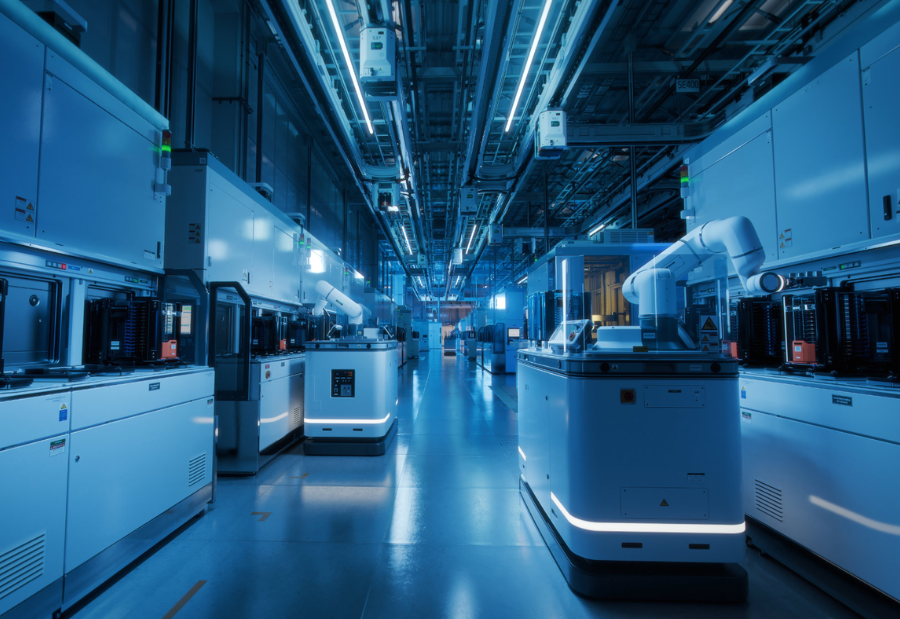
At half past midnight in Kancheepuram’s SEZ, the factory floor glows under UV lights. There are no workers in sight. Only the hum of machines, the swish of robotic arms, soft electronic beeps, and a Ganesha prayer playing on loop break the silence. This is Polymatech, India’s only dark factory, where robots assemble semiconductor chips without human supervision.
Set up in 2018 at Oragadam, Polymatech runs a cleanroom where machines operate 24×7, pausing for just 30 minutes once a year. “I want the engineers to sit outside the shop floor, I don’t want them to work; it’s only the machines that have to work,” said Vishaal Nandam, director at Polymatech.
Robots here assemble semiconductor chips and PCBs used in phones, laptops, and TV backlights. Precision is measured down to nanometres. Stack lights signal machine status—red for errors, yellow for standby, green for normal operations. Engineers work in adjacent rooms, stepping in only every 18 hours to replenish materials, wearing PPE kits and passing through air showers.
India remains behind in robot adoption. The country has a robot density of 9 per 10,000 employees, compared to Asia’s 204 and the global average of 177. South Korea leads with 1,102, followed by Singapore at 770 and China at 470. In 2024, India installed 9,123 industrial robots, nearly half in automobiles. “India continues to grow with a record of over 9,100 units installed in 2024—up 7 percent year-on-year,” said Carsten Heer of the International Federation of Robotics.
Polymatech operates 25 robots per 100 employees. It plans a new facility in Chhattisgarh and a ‘zero manpower’ unit in Singapore. Around 500 kilometres away in Coimbatore, startup xLogic Labs is building its own robots in a garage prototype facility. CEO Dhanush Baktha said, “Anyone looking to set up a dark factory will have to spend at least 4-5 times more than we are spending because they will have to import machines, and we’re building them on our own.”
Yet automation brings concern. Manufacturing contributes 16–17 per cent of GDP, while 22.15 per cent of workers are low-skilled and 66.89 per cent semi-skilled. “There is no question there is a skills crisis,” said Santosh Mehrotra. Training institutes are now offering courses in robotics, PLC, HMI, and SCADA to prepare students for automated factory floors.
Dark factories represent two realities: global competitiveness and job displacement. For now, the race has just begun.
Also read: Viksit Workforce for a Viksit Bharat
Do Follow: The Mainstream formerly known as CIO News LinkedIn Account | The Mainstream formerly known as CIO News Facebook | The Mainstream formerly known as CIO News Youtube | The Mainstream formerly known as CIO News Twitter
About us:
The Mainstream is a premier platform delivering the latest updates and informed perspectives across the technology business and cyber landscape. Built on research-driven, thought leadership and original intellectual property, The Mainstream also curates summits & conferences that convene decision makers to explore how technology reshapes industries and leadership. With a growing presence in India and globally across the Middle East, Africa, ASEAN, the USA, the UK and Australia, The Mainstream carries a vision to bring the latest happenings and insights to 8.2 billion people and to place technology at the centre of conversation for leaders navigating the future.