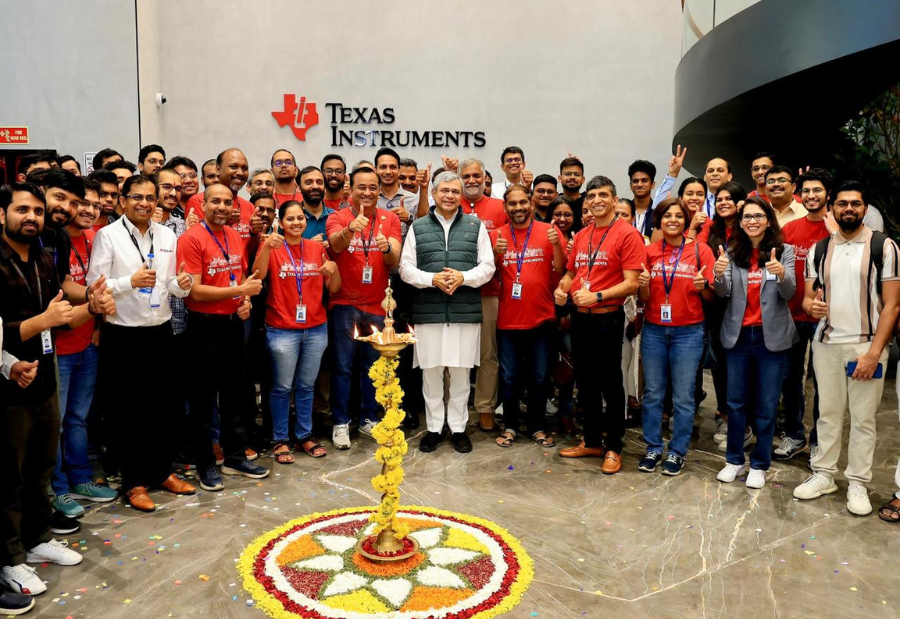
At a time when India is seeing renewed momentum in advanced chip design, Texas Instruments has strengthened its presence by opening a new semiconductor research and development centre in Bengaluru. The move underlines India’s growing role in global engineering and chip design operations.
The newly launched facility houses multiple integrated circuit design laboratories along with an end-to-end reliability lab. The reliability lab is designed to test semiconductor products across varied environmental conditions, supporting full lifecycle development.
The centre was inaugurated by Union Minister for Electronics and Information Technology Ashwini Vaishnaw. He said Texas Instruments has played a pioneering role in India’s semiconductor journey and has contributed significantly to building the country’s semiconductor design talent base.
Texas Instruments stated that the new R&D centre will deepen its capabilities in analogue and embedded processing technologies. The company added that the expansion will also improve its ability to support customers and strengthen the broader electronics design ecosystem in India.
The development comes as India continues to attract semiconductor investments focused on design and engineering. Just last week, Qualcomm unveiled its 2 nm chip, highlighting India’s increasing importance in advanced semiconductor design and global engineering programmes.
The minister noted that progress under India’s semiconductor push is accelerating, with 10 units currently under construction and 4 units having recently started pilot production.
Other global semiconductor companies are also expanding their design centres and engineering teams across Bengaluru, Hyderabad, and Noida, further reinforcing India’s position as a key design hub.
Government policy in 2026 continues to align with this trend. Under the India Semiconductor Mission, public statements have consistently highlighted design capabilities, talent development, and ecosystem readiness as core pillars, alongside manufacturing and packaging initiatives.
For the technology and channel ecosystem, the expansion of semiconductor design centres is sustaining demand for engineering services, testing support, and embedded software skills. System integrators, ER&D service providers, and global capability centre partners remain closely involved through long-term product lifecycle engagements.
Texas Instruments noted that it was the first multinational company to set up a semiconductor R&D centre in India in 1985. Over the past 4 decades, it has steadily expanded its footprint, supported by a large local workforce and growing customer engagement. The company has also recently opened an additional sales office to strengthen ties with Indian customers.
As global chipmakers spread product development across regions, India continues to remain central to semiconductor design and engineering execution.
Also read: Viksit Workforce for a Viksit Bharat
Do Follow: The Mainstream formerly known as CIO News LinkedIn Account | The Mainstream formerly known as CIO News Facebook | The Mainstream formerly known as CIO News Youtube | The Mainstream formerly known as CIO News Twitter
About us:
The Mainstream is a premier platform delivering the latest updates and informed perspectives across the technology business and cyber landscape. Built on research-driven, thought leadership and original intellectual property, The Mainstream also curates summits & conferences that convene decision makers to explore how technology reshapes industries and leadership. With a growing presence in India and globally across the Middle East, Africa, ASEAN, the USA, the UK and Australia, The Mainstream carries a vision to bring the latest happenings and insights to 8.2 billion people and to place technology at the centre of conversation for leaders navigating the future.