


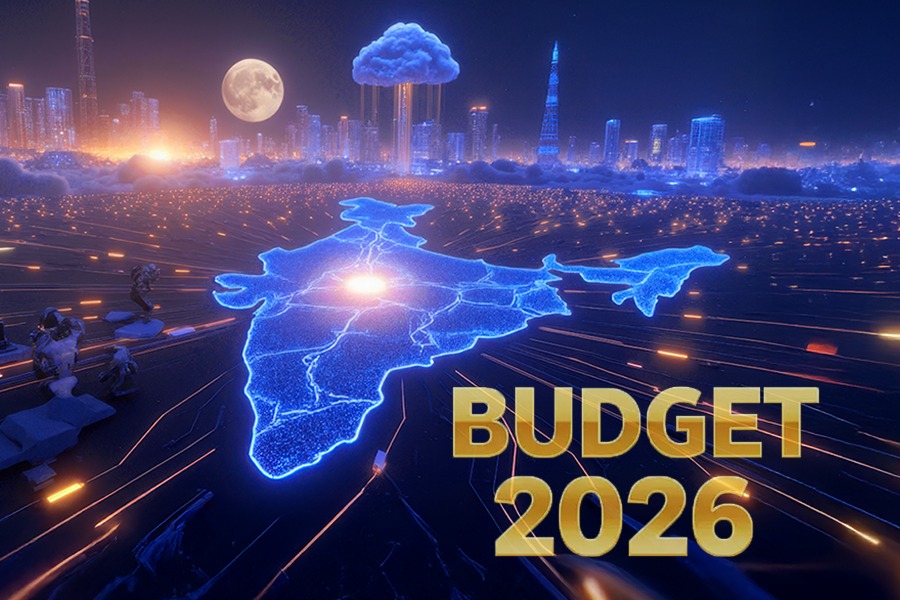
The Union Budget 2026–27, presented by Finance Minister Nirmala Sitharaman, placed artificial intelligence (AI), cloud infrastructure and semiconductor manufacturing at the core of India’s technology and economic roadmap. While the Budget refrained from announcing direct startup-specific tax incentives, it made strategic, long-term bets on digital infrastructure and deep tech, prompting India’s startup ecosystem to read beyond the headlines.
For founders, investors and operators, Budget 2026 signals where the government wants India’s innovation economy to head, even if immediate relief remains limited.
Tech as Strategy
Unlike earlier budgets that leaned on targeted incentives, Budget 2026 adopts a platform-first and infrastructure-led approach to technology-led growth. AI, cloud computing, data centres, and advanced manufacturing were positioned as foundational enablers for India’s next phase of economic expansion.
The government’s messaging was clear: build the rails first, and let private innovation scale on top of it. For startups, this means opportunity — but with patience and execution risk.
Semiconductors Get a Strong Policy Signal With ISM 2.0
One of the most consequential announcements for the tech ecosystem was the launch of India Semiconductor Mission (ISM) 2.0. The expanded mission aims to strengthen India’s domestic semiconductor value chain — from chip design and fabrication to electronics components and advanced manufacturing.
With enhanced allocations and policy backing, ISM 2.0 is expected to benefit:
- Chip design startups
- Hardware and embedded systems companies
- AI accelerator and edge computing firms
- Electronics and IoT innovators
While outcomes will play out over the long term, ecosystem observers see this as a structural push for deep tech, a segment that has traditionally struggled with capital intensity and infrastructure gaps in India.
Cloud & Data Centres: Playing the Long Game
Budget 2026 doubled down on India’s ambition to become a global cloud and data centre hub.
Key measures include:
- Long-term tax incentives extending up to 2047 for foreign cloud service providers using Indian data centres to serve global customers
- Continued policy support for data centre infrastructure and equipment rationalisation
For startups, especially SaaS, fintech, AI, and data-heavy platforms, this could translate into better access to scalable infrastructure and, over time, lower cloud and compute costs as hyperscalers deepen their footprint in India. However, the benefits are expected to be indirect and gradual, rather than immediate.
AI Takes the Spotlight, But Startups Want More
Artificial intelligence was referenced repeatedly in the Budget speech, reinforcing its position as a national priority. The launch of Bharat-VISTAAR, a multilingual AI-powered advisory platform for farmers, underscored the government’s focus on public-sector AI platforms.
Yet, despite the narrative push, Budget 2026 stopped short of introducing direct AI startup incentives, such as:
- Subsidised GPU or compute access
- AI research grants
- Structured public data-sharing frameworks
This suggests a model where the government builds large-scale AI infrastructure and platforms, while startups are expected to innovate on top of them — rather than receive standalone financial support.
Compliance Relief for Scaling Tech Companies
In a move welcomed by mid-stage and growth-stage tech firms, the government raised the safe harbour threshold for IT and IT-enabled services from ₹300 crore to ₹2,000 crore.
The change is expected to:
- Reduce transfer pricing disputes
- Simplify compliance
- Provide greater tax certainty for export-oriented SaaS and IT services companies
While not startup-exclusive, the measure improves ease of doing business for fast-scaling tech companies navigating global markets.
Funding Support Comes Via SME Route
Budget 2026 announced a ₹10,000 crore SME Growth Fund and expanded credit support mechanisms aimed at improving access to capital for small and medium enterprises.
For startups operating as MSMEs or building product-led businesses outside traditional VC ecosystems, these measures could provide alternative financing pathways. However, the absence of a clearly articulated deep-tech or innovation-focused fund was noted by ecosystem stakeholders.
What Startups Didn’t Get?
Despite its strong tech focus, the Budget left several long-standing startup demands unaddressed, including:
- ESOP taxation reforms
- Capital gains tax relief for startup investors
- Preferential government procurement for startups
- Direct startup or founder-focused tax incentives
As a result, many founders see Budget 2026 as enabling but not founder-first.
The Bigger Picture for India’s Startup Ecosystem
Union Budget 2026 reflects a clear strategic intent: build national technology infrastructure and let innovation scale organically. For startups, the opportunity lies in aligning with these macro priorities: AI platforms, semiconductor manufacturing, cloud infrastructure and digital public systems.
While immediate incentives may be limited, the Budget lays the groundwork for a more resilient, globally competitive tech ecosystem over the next decade. Startups that can plug into this infrastructure, rather than wait for direct relief may stand to benefit the most.
Also read: Viksit Workforce for a Viksit Bharat
Do Follow: The Mainstream formerly known as CIO News LinkedIn Account | The Mainstream formerly known as CIO News Facebook | The Mainstream formerly known as CIO News Youtube | The Mainstream formerly known as CIO News Twitter
About us:
The Mainstream is a premier platform delivering the latest updates and informed perspectives across the technology business and cyber landscape. Built on research-driven, thought leadership and original intellectual property, The Mainstream also curates summits & conferences that convene decision makers to explore how technology reshapes industries and leadership. With a growing presence in India and globally across the Middle East, Africa, ASEAN, the USA, the UK and Australia, The Mainstream carries a vision to bring the latest happenings and insights to 8.2 billion people and to place technology at the centre of conversation for leaders navigating the future.