


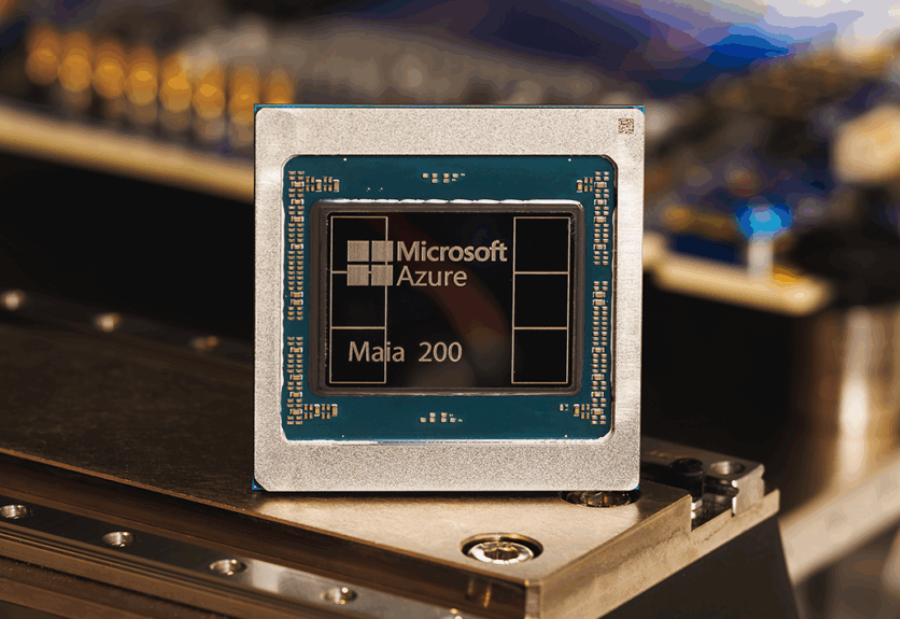
Expanding its in-house silicon strategy, Microsoft has introduced the next generation of its artificial intelligence chip and new software tools aimed at developers. The company revealed the second-generation Maia chip, called “Maia 200,” alongside programming tools designed to reduce reliance on Nvidia’s ecosystem.
The Maia 200 is now live at a Microsoft data center in Iowa, with a second deployment planned in Arizona. It follows the first Maia chip that Microsoft launched in 2023. The move comes as large cloud providers such as Microsoft, Google, and Amazon Web Services, which are among Nvidia’s biggest customers, continue building their own chips that compete directly with Nvidia products.
Microsoft said it will also release a set of software tools to program the new chip. This includes “Triton,” an open-source tool with major contributions from OpenAI, which performs similar functions to “Cuda,” Nvidia’s widely used developer software. Analysts often describe Cuda as one of Nvidia’s strongest competitive advantages.
Like Nvidia’s upcoming “Vera Rubin” chips announced earlier this month, the Maia 200 is manufactured by Taiwan Semiconductor Manufacturing Co using 3-nanometer technology. It will also use high-bandwidth memory, though an older and slower version compared with Nvidia’s next-generation chips.
Microsoft has added a large amount of SRAM to the Maia 200 design. SRAM is a type of memory that can improve speed when AI systems handle many user requests at the same time, such as in chatbot services. This design approach mirrors strategies used by newer competitors in the AI chip market.
Cerebras Systems, which recently signed a $10 billion deal with OpenAI to supply computing power, also relies heavily on SRAM-based designs. Groq, another AI chip startup, follows a similar approach and has licensed technology to Nvidia in a reported $20 billion deal.
The Maia 200 launch reflects a wider trend in the cloud industry, where major firms are reducing dependence on external chip suppliers by building custom hardware and software stacks. Microsoft’s combined focus on silicon and developer tools signals a direct effort to close the gap with Nvidia in both performance and software support.
Also read: Viksit Workforce for a Viksit Bharat
Do Follow: The Mainstream formerly known as CIO News LinkedIn Account | The Mainstream formerly known as CIO News Facebook | The Mainstream formerly known as CIO News Youtube | The Mainstream formerly known as CIO News Twitter
About us:
The Mainstream is a premier platform delivering the latest updates and informed perspectives across the technology business and cyber landscape. Built on research-driven, thought leadership and original intellectual property, The Mainstream also curates summits & conferences that convene decision makers to explore how technology reshapes industries and leadership. With a growing presence in India and globally across the Middle East, Africa, ASEAN, the USA, the UK and Australia, The Mainstream carries a vision to bring the latest happenings and insights to 8.2 billion people and to place technology at the centre of conversation for leaders navigating the future.