


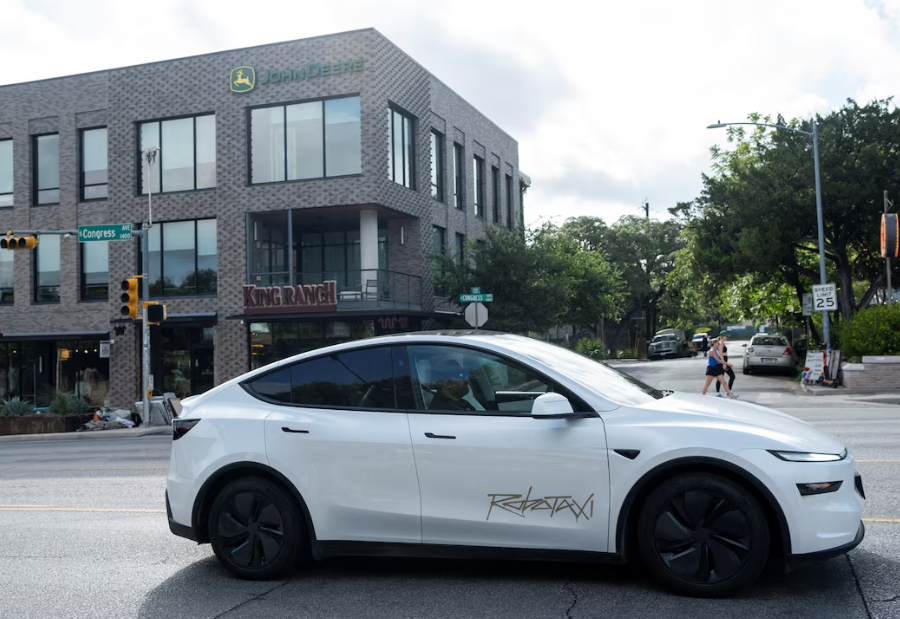
A long-running vision around self-driving transport has moved a step closer to reality as Tesla rolled out driverless robotaxi rides in Austin, Texas. The development was confirmed by CEO Elon Musk in a post on X, where he congratulated the Tesla AI team and invited engineers interested in “solving real-world AI” to join the company.
The launch represents a significant moment for Tesla’s autonomous vehicle programme, which has been under development for several years. Austin has served as the testing ground for Tesla’s robotaxi ambitions, with the company following a phased approach to reach fully driverless operations.
Tesla first introduced robotaxi rides in Austin in June last year. At that stage, a safety operator was seated in the front passenger seat, and access to the service was limited to influencers and selected customers. In December, Tesla began testing robotaxis without a safety driver, signalling a gradual shift towards unsupervised operation. However, not every vehicle in Tesla’s fleet is fully driverless at this point.
Commenting on the rollout strategy, Tesla’s AI lead Ashok Elluswamy said the company plans to steadily increase the number of unsupervised vehicles within its wider robotaxi fleet, supported by safety monitors. He noted that the ratio of unsupervised vehicles will grow over time. It remains unclear whether Tesla is charging passengers for these rides or offering them free of cost.
This measured expansion mirrors the approach used by competitors such as Waymo, which also started with a small number of vehicles before scaling operations. Despite the technical progress, Tesla’s robotaxi service is still not widely accessible. Entry continues to depend on customer waitlists, limiting public availability.
The restricted access has drawn criticism from some observers, who argue that the rollout functions more as a showcase than a fully deployable service at scale. Concerns have also been raised around safety. Even with safety monitors, Tesla’s robotaxis have reportedly been involved in around 8 crashes over a span of 5 months, according to a tech publication.
These incidents have sparked questions about system reliability and readiness for broader use. Still, Musk has continued to express confidence in Tesla’s trajectory, maintaining that the company is well positioned to lead the future of autonomous driving.
Also read: Viksit Workforce for a Viksit Bharat
Do Follow: The Mainstream formerly known as CIO News LinkedIn Account | The Mainstream formerly known as CIO News Facebook | The Mainstream formerly known as CIO News Youtube | The Mainstream formerly known as CIO News Twitter
About us:
The Mainstream is a premier platform delivering the latest updates and informed perspectives across the technology business and cyber landscape. Built on research-driven, thought leadership and original intellectual property, The Mainstream also curates summits & conferences that convene decision makers to explore how technology reshapes industries and leadership. With a growing presence in India and globally across the Middle East, Africa, ASEAN, the USA, the UK and Australia, The Mainstream carries a vision to bring the latest happenings and insights to 8.2 billion people and to place technology at the centre of conversation for leaders navigating the future.