


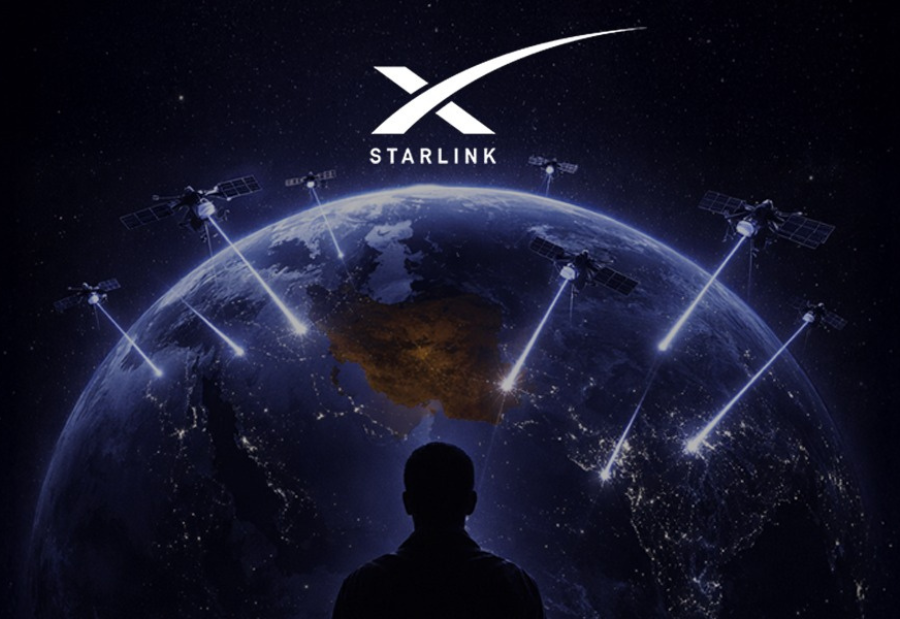
There is a certain paradox to our age. Governments switch off the internet with the same casual certainty with which we turn off a light. And then, unexpectedly, the light returns, not from a telecom tower, but from low-Earth orbit satellites.
The continuing internet blackout in Iran is not the first, and it will not be the last. But it reveals something uncomfortable for every modern state: control over communication is no longer fully terrestrial. Cables lie in the ground. Starlink circles above them. The citizen stands somewhere in the middle, phone in hand, hoping a signal leaks through the silence.
Starlink did not enter this story as a savior. It arrived as terminals, bandwidth, hardware, regulatory questions and orbital mechanics. Yet it has become a central character in the narrative of censorship, digital rights and online access during blackouts.
The blackout itself followed a familiar script, domestic networks throttled, platforms filtered, services cut. Message threads froze mid-sentence. Businesses stalled. Protests disappeared from feeds. In the arithmetic of traditional governance, the switch had been flipped and control restored. Except the numbers suddenly refused to add up.
Satellite internet does not submit quite so easily. Smuggled Starlink terminals in Iran began blinking to life. Messages slipped through. Images resurfaced. The engineered silence became porous. A blackout with holes in it is no longer a blackout. It becomes a narrative problem.
That is where the story changes.
Governments now confront not just dissent, but private orbital infrastructure they do not fully own and cannot fully shut down. Jamming technology ramps up. Counter-measures follow. Legal frameworks twist to catch up. A discussion that begins with connectivity ends up touching sovereignty, cybersecurity, sanctions, spectrum control and space technology, while the citizen simply wants to send a message.
The citizen, in this drama, is not a data point. They are a student trying to submit a file. A family member trying to say “I am safe.” A protester trying to document what might otherwise vanish.
Their “use case,” to borrow the language of the tech industry, is disarmingly simple: to remain online when someone else has decided they should not.
Technology, neutral on paper, rarely behaves neutrally in practice. Satellite internet during censorship can be lifeline, loophole, irritation, threat, commodity or right. Its identity changes with the vantage point. But its presence redraws the boundaries between state authority and digital freedom.
This moment forces harder questions than many would like to ask aloud.
- Who governs communication when the network is in orbit?
- What does national control mean when data crosses borders by default?
- Are connectivity, speech and online presence now inseparable from space technology?
States argue for sovereignty. Companies argue for innovation and markets. Citizens argue for connection, sometimes quietly, sometimes urgently. All three collide at the speed of light, the speed at which data now travels even when it comes from the sky.
Iran’s blackout will eventually end. Blackouts always do. But something has already shifted.
The assumption that turning off terrestrial internet ends conversation belongs to an earlier decade. The present is messier, a mixture of engineering challenge, legal ambiguity, policy dilemma and human stubbornness.
People will always look for signal. If they cannot find it on the ground, they will look upward.
A government may shut down networks. A company may launch constellations. But the real protagonist of this story is neither. It is the citizen, persistent and inventive, discovering that when the earth goes dark, the sky sometimes answers back.
Also read: Viksit Workforce for a Viksit Bharat
Do Follow: The Mainstream formerly known as CIO News LinkedIn Account | The Mainstream formerly known as CIO News Facebook | The Mainstream formerly known as CIO News Youtube | The Mainstream formerly known as CIO News Twitter
About us:
The Mainstream formerly known as CIO News is a premier platform dedicated to delivering latest news, updates, and insights from the tech industry. With its strong foundation of intellectual property and thought leadership, the platform is well-positioned to stay ahead of the curve and lead conversations about how technology shapes our world. From its early days as CIO News to its rebranding as The Mainstream on November 28, 2024, it has been expanding its global reach, targeting key markets in the Middle East & Africa, ASEAN, the USA, and the UK. The Mainstream is a vision to put technology at the center of every conversation, inspiring professionals and organizations to embrace the future of tech.