


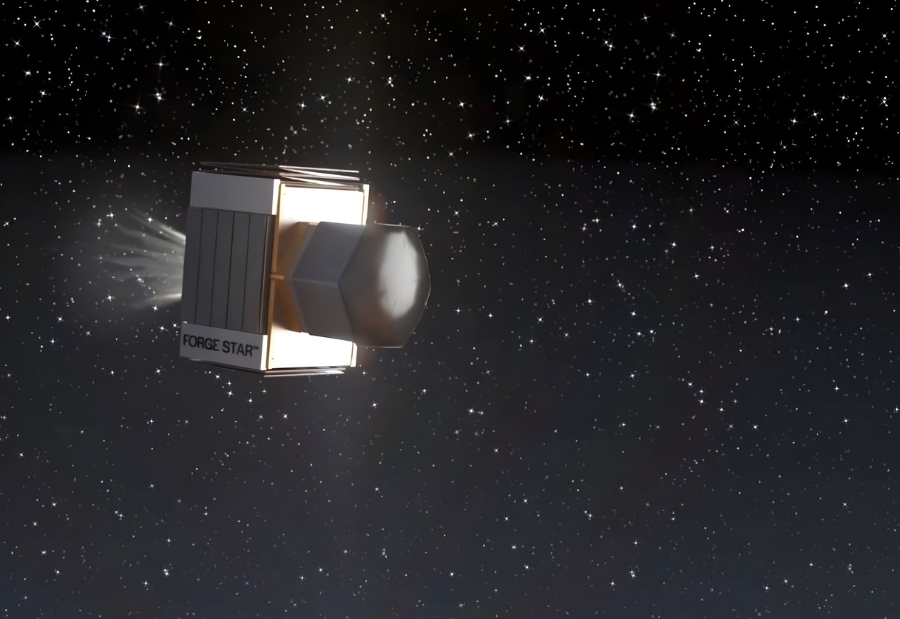
Marking a major step toward space-based manufacturing, UK-based Space Forge has successfully generated its first plasma in orbit aboard the ForgeStar-1 satellite. This milestone moves the company closer to its goal of producing next-generation semiconductors in space, a process that until now has only been tested aboard the International Space Station.
Space Forge launched ForgeStar-1 in June 2025 and has been gradually activating its systems in orbit. In December 2025, the microwave oven-sized satellite powered up its onboard miniature furnace for the first time and produced plasma at temperatures reaching 1,832 degrees Fahrenheit (1,000 degrees Celsius). This plasma will play a central role in future missions aimed at creating advanced materials in a weightless environment.
“Generating plasma on orbit represents a fundamental shift, it proves that the essential environment for advanced crystal growth can be achieved on a dedicated, commercial satellite — opening the door to a completely new manufacturing frontier,” Joshua Western, CEO and co-founder of Space Forge, said in a statement.
Founded in 2018, Space Forge plans to use similar furnace technology on future satellites to manufacture novel semiconductors directly in low Earth orbit. Until now, comparable experiments had only been conducted aboard the International Space Station.
“The plasma demonstration confirms that the extreme conditions needed for gas-phase crystal growth — a core building block of semiconductor production — can now be created and controlled on an autonomous platform in low Earth orbit,” the company said. “The achievement establishes ForgeStar-1 as the first free-flying commercial semiconductor manufacturing tool ever operated in space.”
In microgravity, atoms in semiconductors can align more precisely than on Earth. Space Forge estimates that this improved structure could reduce energy consumption in electronic devices by up to 60 percent. The materials under development include gallium nitride, silicon carbide, and diamond, which could be used in future telecommunications systems, electronic devices, and next-generation computing.
ForgeStar-1 is designed mainly as a technology demonstrator. The satellite is expected to deorbit and burn up in the atmosphere later this year. Before that, it will conduct additional experiments to study plasma behaviour in microgravity and gather data to refine future missions.
In 2025, Space Forge raised £22.6 million ($30.5 million) in Series A funding. The capital will support the development of ForgeStar-2, which is planned to manufacture the company’s first batch of space-made semiconductors and return them safely to Earth using a newly designed heat shield.
Also read: Viksit Workforce for a Viksit Bharat
Do Follow: The Mainstream formerly known as CIO News LinkedIn Account | The Mainstream formerly known as CIO News Facebook | The Mainstream formerly known as CIO News Youtube | The Mainstream formerly known as CIO News Twitter
About us:
The Mainstream is a premier platform delivering the latest updates and informed perspectives across the technology business and cyber landscape. Built on research-driven, thought leadership and original intellectual property, The Mainstream also curates summits & conferences that convene decision makers to explore how technology reshapes industries and leadership. With a growing presence in India and globally across the Middle East, Africa, ASEAN, the USA, the UK and Australia, The Mainstream carries a vision to bring the latest happenings and insights to 8.2 billion people and to place technology at the centre of conversation for leaders navigating the future.